English

GYTC8A Aluminum Tape Armored Self-supporting Aerial FIG8 Fiber Optic Cable
| Model | GYTC8A |
| Fiber Counts | 2core - 288core |
| Structure | FIGURE-8 design |
| Buffer Tube | Stranded Loose Tube |
| Messenger | Stranded Steel Wires |
| Central Strength Member (CSM) | Steel Wire (or FRP) |
| Moisture Proof | Cable Filling Compound |
| Armor | Aluminum Tape |
| Outer Sheath | PE (polyethylene) |
| Application | Self-supporting Aerial Laying |
| Drum Length | 2km, 3km ,4km or customized |
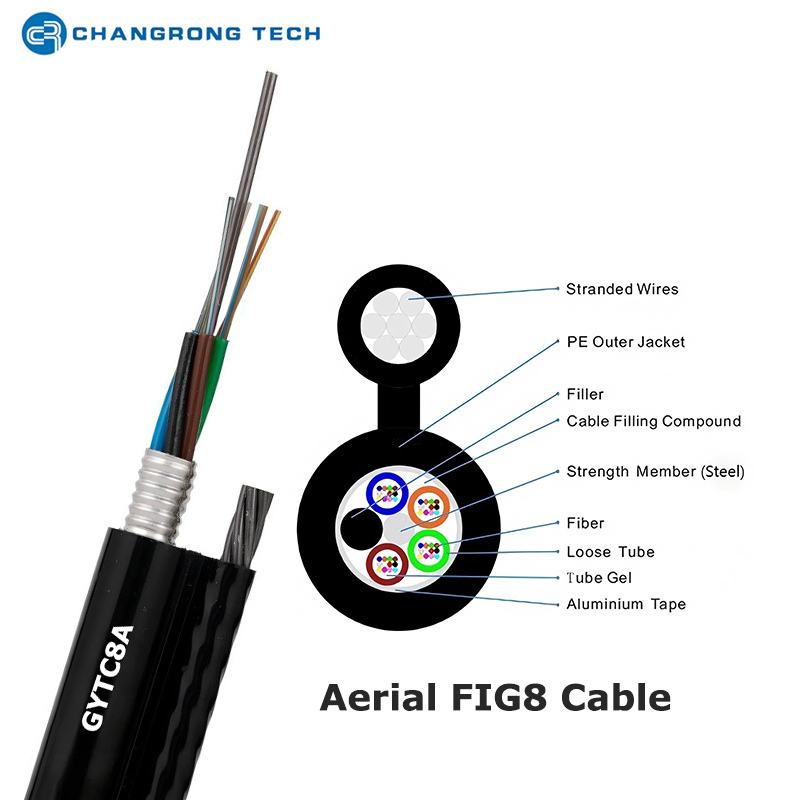
Basic Description of GYTC8A Aerial FIG8 Fiber Optic Cable:
GYTC8A fiber optic cable is a type of self-supporting aerial cable with stranded steel messenger and aluminium tape light-armored, designed for outdoor long-distance aerial laying. It's core advantage lies in the "FIG8" (figure-of-eight) structure, which integrates a load-bearing element (strength member) with the cable body—eliminating the need for separate suspension wires.
GYTC8A Model Definition:
"GY" : outdoor communication use
"T" : loose tube filled with water-blocking gel, filler
"C" : self-supporting
"8" : FIG8 structure
"A" : Aluminum tape armored
GYFTC8A Model Definition:
"GY" : outdoor communication use
"F" : FRP central strength member
"T" : loose tube filled with water-blocking gel, filler
"C" : self-supporting
"8" : FIG8 structure
"A" : Aluminum tape armored
The main difference between GYTC8A cable and GYFTC8A cable lies in the Central Strength Member (CSM):
| Model | Construction | Sheath Shape | CSM | Inatallation |
| GYTC8A | Stranded Loose Tube | FIG8 | Steel Wire | Self-supporting Aerial Laying |
| GYFTC8A | Stranded Loose Tube | FIG8 | FRP | Self-supporting Aerial Laying |
Detailed Structure of GYTC8A Self-supporting FIG8 Aerial Cable:
Fiber Core: The 250µm single-mode fibers are placed in loose tubes made of high - modulus materials, and the loose tubes are filled with waterproof compounds to protect the fibers.
Central Strength Member(CSM): A metal (usually steel wire) central strength member is located in the center of the cable core, which provides basic tensile strength for the optical cable.
Cable Core: The loose tubes and filling ropes are stranded around the central strength member to form a compact and circular cable core.
Armoring Layer: The cable core is longitudinally wrapped with a layer of coated aluminum tape (APL) to form a moisture - proof layer, which can prevent water vapor from entering the cable core.
Sheath: The armored cable core and the stranded steel wires are integrated into an 8 - shaped polyethylene (PE) sheath. The stranded steel wires is used for self - supporting, and the PE sheath plays a role in protecting the internal structure and providing certain mechanical properties.

GYTC8A FIG8 Cable

GYTC8A Structure Diagram

GYFTC8A FIG8 Cable

GYFTC8A Structure Diagram
Features:
GYTC8A cables leverage the FIG8 self-supporting design and aluminum armor to deliver unique benefits.
(1) Self-Supporting (FIG8 Structure): The load-bearing stranded wires (with steel/FRP strength member) directly attaches to utility poles via clamps—no need for a separate messenger wire. This reduces installation time, labor, and cost (critical for rural or remote areas).
(2) Aluminum Tape Armor Protection:
Moisture/Oxygen Barrier: Aluminum is impermeable to water and oxygen, preventing fiber degradation (e.g., hydrogen-induced attenuation).
Lightweight & Flexible: Aluminum armor is lighter than steel armor (GYTS series), making the cable easier to transport and install aerially.
(3) Weather Resistance: PE outer sheath resists UV radiation, ozone, and extreme temperatures (-40°C to +70°C), ensuring long-term reliability (service life ≥25 years).
(4) High Tensile Strength: The central strength member (steel/FRP) and FIG8 load-bearing lobe support the cable's self-weight and wind load (typical tensile rating: 1.5–3kN for short spans, 5–10kN for long spans).
(5) Water Blocking: Water-blocking gel in loose tubes and water-swellable tapes (optional) around the core prevent water from spreading along the cable (critical for aerial deployment, where rain or dew can seep in).
Applications:
Backbone Network: It can be used in the construction of long - distance backbone networks to transmit a large amount of optical signals.
Metropolitan Area Network: Suitable for metropolitan area network construction, connecting various nodes in the city to realize high - speed data transmission.
FTTX (Fiber to the x): It is an important part of the access network in the FTTX project, such as Fiber to the Home (FTTH) and Fiber to the Building (FTTB), which can realize the connection from the central office to the end-user.
Reel Length:
normally 2km, 3km, 4km, 5km (as your request)
Drum options: Fumigated Wooden Drum, Steel-reinforced Wooden Drum, Plywood Drum.
Cable and Drum Marking according to customer's requirements.

Shipping Pictures:


