English


GCYFTY Stranded Loose Tube Air-Blowing Non-metallic Microduct Fiber Optic Cable
| Model | GCYFTY |
| Fiber Counts | 2core - 288core |
| Structure | Stranded Loose Tube |
| Central Strength Member (CSM) | FRP (Non-metallic) |
| Moisture Resistance | Water-blocking yarn |
| Outer Sheath | PE (Polyethylene) |
| Application | Air-blowing Micro Duct Laying |
| Drum Length | 2km, 3km, 4km |
Basic Description:
GCYFTY (also called GCYFY) is a specialized non-metallic, air-blowing microduct fiber optic cable designed for efficient deployment in microduct systems. It integrates the advantages of stranded loose-tube construction (for fiber protection and flexibility) and non-metallic components (for lightweight, corrosion resistance, and non-conductivity), making it ideal for scenarios requiring fast, low-cost installation and reliable optical signal transmission.
GCYFTY belongs to the category of microduct fiber optic cables—a type of compact cable optimized for installation via "air-blowing" (using high-pressure air to push the cable through pre-laid microducts, typically 5-16mm in inner diameter). Its core function is to transmit high-bandwidth optical signals (e.g., data, video, voice) in small-diameter ducts, with a focus on easy installation, space-saving, and environmental adaptability.
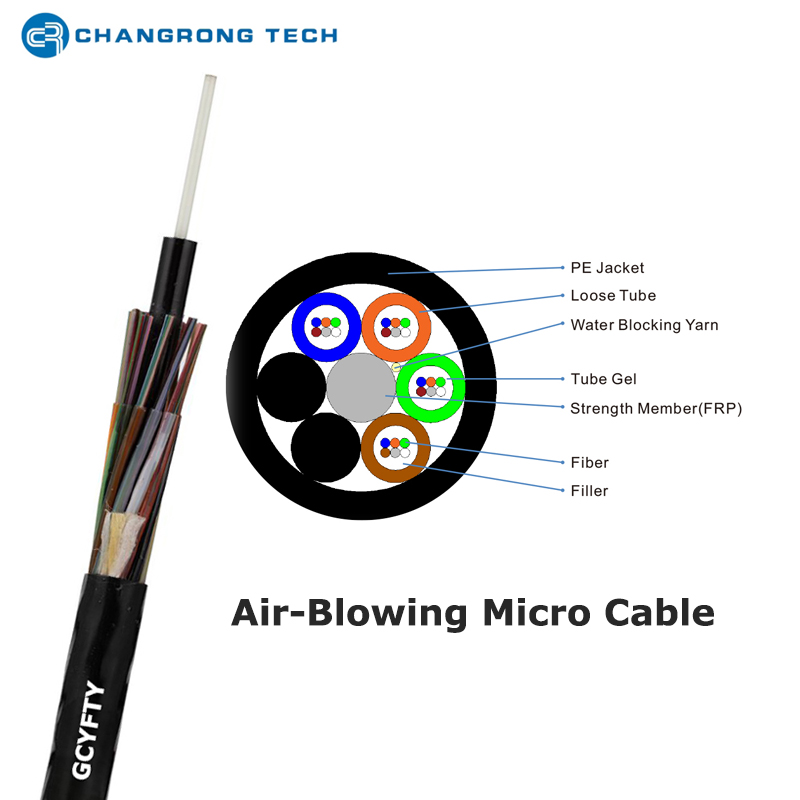
Detailed Structure of GCYFTY Air Blown Micro Cable:
GCYFTY cable structure is layered and compact, balancing protection, flexibility, and compatibility with microducts. Below is a detailed breakdown from the inner core to the outer sheath:
| Layer | Component Name | Material & Specifications | Function |
| 1. Optical Fiber Core | Optical Fibers | Single-mode (e.g., G.652D, G.657A1) or multimode (e.g., G.651) fibers; 2-12 fibers/tube | Transmit optical signals; G.657A1 fibers are bend-insensitive (ideal for microducts). |
| 2. Buffer Layer | Loose Buffer Tubes | Polybutylene terephthalate (PBT); inner diameter ~1.5-2.0mm | Isolate fibers from mechanical stress (e.g., bending, stretching); filled with water-blocking gel. |
| 3. Central Reinforcement | Non-metallic Strength Member | Fiber-reinforced plastic (FRP); diameter ~1.0-2.0mm | Provide tensile strength (replace metal wires); avoid electromagnetic interference (EMI). |
| 4. Stranding Layer | Stranded Loose Tubes with filler | 2-6 loose tubes stranded around the central member (helical pitch: 50-100mm) | Enhance cable flexibility; prevent fiber breakage during bending/air-blowing. |
| 5. Water-Blocking Layer | Water-Swelling Yarn/Tape | Water-swellable polyester yarn or tape (wrapped around stranded tubes) | Block water ingress (critical for outdoor/underground use); prevent fiber corrosion. |
| 6. Outer Sheath | Sheath | Low-smoke zero-halogen (LSZH) or polyethylene (PE); thickness ~0.5-1.0mm; total cable diameter ~3-8mm | Protect internal components from abrasion, UV radiation, and chemicals; ensure compatibility with microducts. |

Air Blown Fiber Cable

GCYFTY cable structure
Features of GCYFTY Air-blowing Microduct Fiber Optic Cable:
Compact diameter: Total cable diameter (3-8mm) matches standard microducts (5-16mm inner diameter), minimizing air resistance during installation.
Smooth sheath: The outer PE/LSZH sheath has a low-friction surface, allowing the cable to be blown 500-1500 meters in a single run (reducing splice points and installation time).
No EMI/RFI interference: No metal components (e.g., steel wires, copper conductors) mean it is immune to electromagnetic interference (EMI) from power lines or radio frequency interference (RFI)—critical for data centers, industrial control systems, or near high-voltage equipment.
Lightweight: Density ~0.9-1.2 g/cm³ (far lower than metal-armored cables), reducing load on duct systems and simplifying manual handling.
Corrosion resistance: FRP/GRP and plastic materials resist moisture, salt spray, and chemicals, making it suitable for coastal, underground, or harsh industrial environments.
Loose-tube design: Fibers float freely in the PBT tube (filled with water-blocking gel), avoiding direct mechanical stress (e.g., stretching, compression) during installation or operation.
Bend insensitivity: Compatible with G.657A1/A2 fibers, which tolerate tight bends (minimum bend radius: 5mm for static, 10mm for dynamic) without signal loss—ideal for microducts with complex routing.
Wide temperature range: Operates in -40°C to +70°C (PE sheath) or -20°C to +60°C (LSZH sheath), suitable for both cold northern regions and hot outdoor environments.
Flame retardancy (LSZH option): LSZH sheath emits low smoke and no toxic halogens when burned, meeting fire safety standards (e.g., IEC 60332-1) for indoor spaces (e.g., data centers, buildings).
Applications:
Deployed in microducts for "last-mile" connectivity (FTTH: Fiber-to-the-Home, FTTP: Fiber-to-the-Premises). The air-blowing method allows quick installation in existing underground ducts or building risers, reducing disruption to residents.
Used for internal backbone connections (e.g., between server racks, floors, or data halls). Its non-metallic structure avoids EMI with sensitive IT equipment, and the compact design saves space in crowded cable trays.
Applied in factories, power plants, or oil refineries for connecting sensors, controllers, and monitoring systems. Resists corrosion from chemicals and EMI from heavy machinery, ensuring stable signal transmission.
Installed in microducts under sidewalks, roads, or green spaces for smart lighting, traffic management, or public Wi-Fi networks. The non-metallic design eliminates the risk of electric shock during maintenance, and air-blowing reduces road excavation.
Used in train stations or subway systems for communication (e.g., passenger information displays, security cameras). The lightweight and flexible structure adapts to vibration and tight routing in tunnels or station ceilings.
Reel Length:
normally 2km, 3km, 4km, 5km (as your request)
Drum options: Fumigated Wooden Drum, Steel-reinforced Wooden Drum, Plywood Drum.
Cable and Drum Marking according to customer's requirements.

Shipping Pictures:


