English

GYFTA Outdoor Stranded Loose Tube Aluminum Tape Armored Duct Fiber Optic Cable
| Model | GYFTA |
| Fiber Counts | 2core - 288core |
| Structure | Stranded Loose Tube |
| Central Strength Member (CSM) | FRP (Glass Fiber Reinforced Plastic) |
| Moisture proof | Filling compound/ water-blocking tape |
| Armor material | Aluminum Tape |
| Outer sheath | PE or LSZH |
| Delivery Length | 2km, 3km, 4km, 5km |
Basic Description:
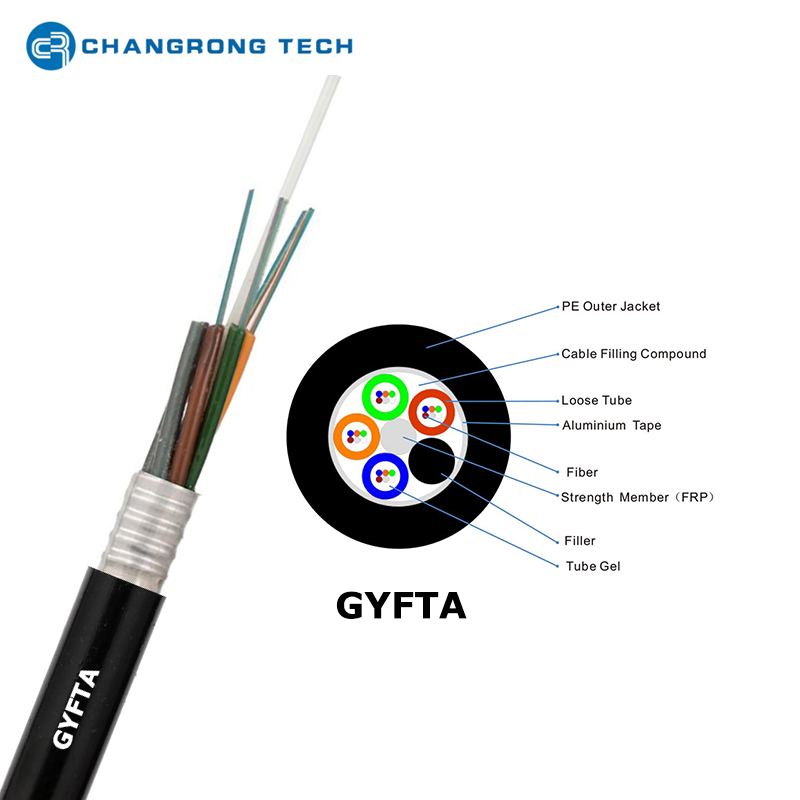
The GYFTA cable is a stranded loose-tube, aluminum tape-armored optical fiber cable optimized for outdoor duct environments. Unlike aerial cables (e.g., GYXTW) or direct-buried cables (e.g., GYTA53), it relies on pre-laid ducts (PVC, HDPE, or steel pipes) for physical protection, while its internal structure enhances resistance to moisture, corrosion, and minor external impacts during duct installation and long-term operation.
It is specifically designed for outdoor duct (pipe) laying scenarios (e.g., buried underground pipelines, municipal utility tunnels) and integrates mechanical protection, environmental resistance, and stable signal transmission.
Its core positioning: A cost-effective, reliable transmission medium for medium-to-long-distance outdoor communication networks (e.g., telecom backbone lines, 5G base station backhauls, smart city infrastructure) where duct laying is feasible.
Detailed Structure of GYFTA Armored Fiber Optic Cable:
| Layer No. | Component name | Material & Specifications | Function |
| 1 | Optical Fiber core | Single-mode (SM, e.g., G.652D, G.657A1) or Multimode (MM, e.g., OM3, OM4) fibers | Transmit optical signals (core of the cable) |
| 2 | Loose buffer tube | PBT, diameter ~1.8-3.0mm | Isolate fibers from external stress; fill with water-blocking gel to prevent moisture |
| 3 | Stranding layer | - Loose tubes stranded around a central strength member (FRP rod) - Filler rods (if needed) to ensure roundness | Distribute stress evenly; maintain cable shape; enhance tensile strength |
| 4 | Water-blocking tape | Non-woven fabric + water-swellable material | Secondary moisture protection; prevent water seepage along the cable length |
| 5 | Aluminum Tape Armor | 0.2-0.3mm thick aluminum tape (longitudinally wrapped or lapped) | - Block moisture and oxygen (corrosion resistance)- Provide mechanical protection (prevent rodent bites, minor impacts) |
| 6 | Outer sheath | Low-smoke zero-halogen (LSZH) polyethylene or medium-density polyethylene (MDPE) | - Primary protection against abrasion, UV, and chemical corrosion- Meet environmental standards (e.g., RoHS for LSZH) |

GYFTA Cable

GYFTA -48C structure
Features of GYFTA Duct Fiber Optic Cable:
(1) Excellent Environmental Resistance
Moisture & Corrosion Proof: The aluminum tape armor forms a dense barrier against groundwater, humidity, and chemical agents (e.g., soil salts), avoiding fiber attenuation caused by moisture.
UV Stability: The outer sheath (PE/LSZH) resists ultraviolet radiation, ensuring long-term performance even if the duct is exposed to sunlight (e.g., above-ground pipe segments).
(2) Reliable Mechanical Protection
Rodent Resistance: Aluminum tape is hard enough to prevent gnawing by rodents (e.g., rats, moles) that often damage underground cables—critical for duct networks in urban or rural areas.
Tensile & Crush Resistance: The central strength member (FRP/steel) and stranded structure distribute tensile force during duct threading, while the aluminum armor and outer sheath withstand minor crushing (e.g., from soil pressure).
(3) Duct-Laying Adaptability
Flexibility: Compared to rigid steel-armored cables (e.g., GYTA53), GYFTA has better bending performance (minimum bending radius: 10×cable diameter for static use), making it easy to thread through narrow ducts or around bends.
Lightweight: Without heavy steel armor, it is lighter (typically 8-15kg/km for 12-core cables), reducing labor intensity during installation.
(4) Environmental Friendliness (Optional)
LSZH outer sheath options meet low-smoke zero-halogen standards, releasing minimal toxic gas or smoke in case of fire—suitable for duct networks in public areas (e.g., subway tunnels, residential districts).
(5) High Transmission Stability
Loose buffer tubes isolate fibers from external stress (temperature changes, vibration), minimizing micro-bending loss. For single-mode fibers (e.g., G.652D), the cable supports long-distance transmission (up to 80km without amplification) with low attenuation (<0.36dB/km at 1310nm).
Typical Applications of GYFTA Armored Optical Fiber Cable:
GYFTA is widely used in outdoor duct-based communication networks, with core application scenarios including:
(1) Telecom Backbone & Access Networks
Deployed in municipal communication ducts to connect central offices (COs), base stations, and access points (e.g., 5G macro base station backhauls, FTTx (Fiber-to-the-x) trunk lines).
(2) Smart City Infrastructure
Used in ducts for smart grid communication (e.g., connecting substation control systems), intelligent transportation (e.g., traffic signal transmission), and IoT sensor networks (e.g., environmental monitoring sensors).
(3) Industrial & Enterprise Networks
Applied in factory duct systems to transmit data between production lines, control centers, and cloud servers (e.g., automotive factories, logistics warehouses)—the aluminum armor resists industrial dust and minor chemical splashes.
(4) Rural & Suburban Communication
Laid in underground ducts to extend optical networks to rural areas, avoiding damage from harsh outdoor conditions (e.g., wind, rain) and reducing maintenance costs compared to aerial cables.
(5) Indoor-Outdoor Transition (Limited)
In some cases, it can be used for short-distance indoor runs (e.g., from outdoor ducts to building basements) if the environment is dry—though dedicated indoor cables (e.g., GJFJV) are preferred for long indoor segments.
Key Notes for Selection & Use:
Fiber Type: Choose single-mode fibers (G.652D/G.657A1) for long-distance transmission (e.g., backbone lines) or multimode fibers (OM3/OM4) for short-distance, high-bandwidth needs (e.g., enterprise LANs).
Sheath Material: Select LSZH sheaths for public areas or enclosed spaces (fire safety) and PE sheaths for cost-sensitive outdoor duct projects.
Installation Limitations: It is not suitable for direct burial (lacking thick steel armor) or aerial laying (no suspension hardware). Always use pre-laid ducts to ensure protection.
1. Structure Parameter
| Model | GYFTA | ||||||||
| Fiber Type | G652D G655 G657 50/125 62.5/125 | ||||||||
| Fiber Counts | 2-30 | 32-36 | 38-60 | 62-72 | 74-96 | 98-120 | 122-144 | 146-216 | 218-288 |
| Max. fibers per tube | 6 | 6 | 12 | 12 | 12 | 12 | 12 | 12 | 12 |
| Units (Tubes or Fillers) | 6 | 6 | 6 | 6 | 8 | 10 | 12 | 18 | 24 |
| Cable Diameter(mm) | 10.4 | 10.4 | 11.3 | 11.3 | 12.6 | 14.0 | 15.5 | 16.0 | 18.0 |
| Cable Weight(Kg/km) | 86 | 86 | 103 | 103 | 128 | 157 | 193 | 198 | 254 |
| Tensile(N) | Long/Short Term:600/1500 | ||||||||
| Crush(N/100mm) | Long/Short Term:300/1000 | ||||||||
| Min. Bending Radius (mm) | Static/Dynamic:12.5D/25D | ||||||||
| Temperature (℃) | Storage /Operation:-40℃~70℃ | ||||||||
2. Fiber Parameter G652.D (after cable)
Item | Characteristics | Unit | Value | |
Geometrical | Cladding Diameter | μm | 125.0±1.0 | |
Cladding Non-circularity | % | ≤1.0 | ||
Core-Cladding Concentricity Error | μm | ≤0.6 | ||
Core Non-circularity | % | ≤12 | ||
Coating Diameter | μm | 245±10.0 | ||
Coating-Cladding Concentricity Error | μm | ≤12 | ||
Curl Radius | m | ≥4 | ||
Attenuation | Zero Dispersion Slope S0 | ps/nm²km | ≤0.092 | |
1625nm Attenuation | dB/km | ≤0.30 | ||
1383+/-3nm Attenuation | dB/km | ≤0.36 | ||
1310nm Attenuation | dB/km | ≤0.36 | ||
1550nm Attenuation | dB/km | ≤0.22 | ||
Point Discontinuity (1310nm & 1550nm) | dB | ≤0.05 | ||
Attenuation at 1285nm ~ 1330nm compared with 1310nm | dB | ≤0.03 | ||
Attenuation at 1485nm ~1580nm compared with 1550nm | dB | ≤0.03 | ||
Zero Dispersion Wavelength λ0 | nm | 1300≤λ0≤1324 | ||
Dispersion | 1285~1339nm Dispersion | ps/nm/km | ≤3.5 | |
1271~1360nm Dispersion | ps/nm/km | ≤5.3 | ||
1550nm Dispersion | ps/nm/km | 13.3~18.6 | ||
Nominal MFD Value(1310nm) | μm | 8.6-9.5 | ||
MFD Tolerance | μm | ±0.4 | ||
Bending | Cable Cut-off Wavelength λcc | nm | ≤1260 | |
1550nm Macro-bend Induced Attenuation( 100turns with diameter of 60mm ) | dB | ≤0.5 | ||
PMD | Q | 0.01% | ||
Maximum Individual Fiber | ps/√km | 0.2 | ||
M | 20 cables | |||
3. Color Identification (Fiber & Tube)
No. | 1 | 2 | 3 | 4 | 5 | 6 | 7 | 8 | 9 | 10 | 11 | 12 |
Color | Blue | Orange | Green | Brown | Slate | White | Red | Black | Yellow | Violet | Pink | Aqua |

Reel Length:
normally 2km, 3km, 4km, 5km (as your request)
Drum options: Fumigated Wooden Drum, Steel-reinforced Wooden Drum, Plywood Drum.
Cable and Drum Marking according to customer's requirements.

Shipping Pictures:


