English

GYTA Aluminum Tape Armored Fiber Optic Cable for Outdoor Aerial/Duct Installation
| Model | GYTA |
| Fiber Counts | 2/4/6/8/12/24/48/96/144/288 core |
| Buffer Tube | Loose Tube |
| Central Strength Member | Steel Wire |
| Waterproof | Cable Filling Compound |
| Armor | Aluminium Tape (APL) |
| Outer Sheath | PE |
| Operation & Storage Temperature | -40℃~+70℃ |
| Drum Length | 2km, 3km, 4km, 5km |
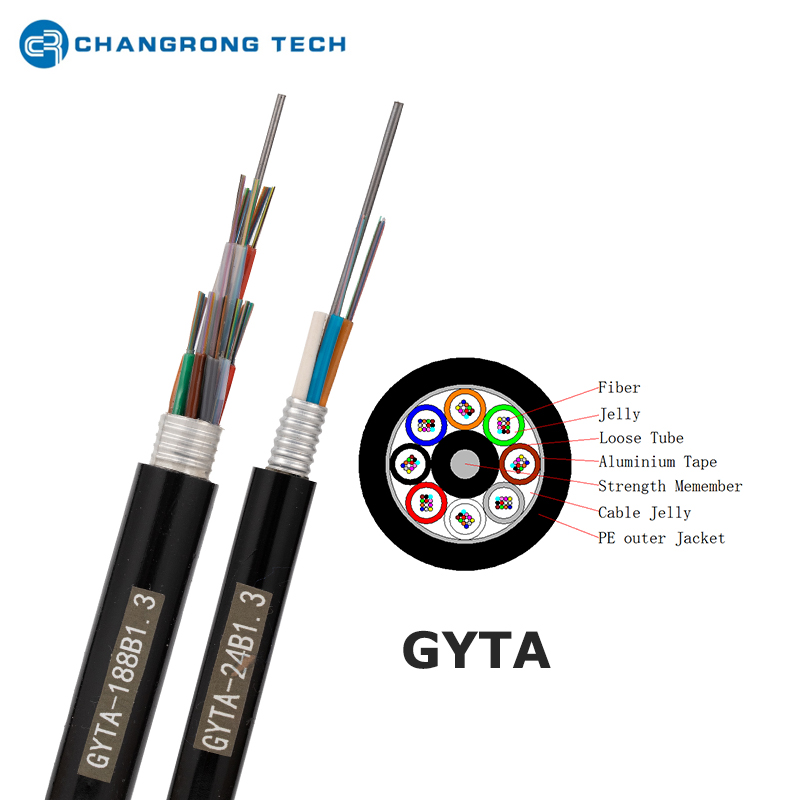
Description of GYTA Armored Fiber Optic Cable:
Key defining characteristics:
Based on the "loose tube" design (fibers are placed in flexible, water-blocked tubes), allowing fiber expansion/contraction with temperature changes (prevents fiber breakage).
Core armor layer uses aluminum tape (instead of steel), balancing lightweight properties (for aerial use) and basic mechanical protection (for duct use).
Complies with international standards such as IEC 60794, GB/T 7424 (China), ensuring compatibility with global network infrastructures.
Detailed Structure of GYTA Cable:
GYTA cable structure follows a "layered protection" logic, from the inner fiber core to the outer sheath. Each layer serves a specific function, collectively ensuring durability and performance.
| No. | Layer Name | Composition | Function |
| 1. | Optical Fiber Unit | Single-mode (SM, e.g., G.652.D, G.657.A1) or Multimode (MM, e.g., G.651) fibers | Transmits optical signals; SM for long distances (>10km), MM for short distances (<2km). |
| 2. | Loose Buffer Tube | PBT | Isolates fibers from external stress; filled with thixotropic water-blocking gel to prevent water ingress. |
| 3. | Central Strength Member | Steel Wire | Bears main mechanical load (e.g., wind, ice for aerial); maintains cable straightness. |
| 4. | Armor layer | Aluminum Tape | Enhances moisture/water resistance (critical for duct use); provides anti-rodent and impact protection (avoids damage from rocks in ducts). |
| 5. | Outer Sheath | UV-resistant PE or low-smoke zero-halogen (LSZH) material | Final protection against UV radiation (aerial), chemical erosion (soil), and physical wear; LSZH option for flame retardancy (e.g., near buildings). |

GYTA Fiber Optic Cable

GYTA-96Core
Features of GYTA Armored Fiber Cable:
Wide temperature range: Operates stably in -40°C (cold regions) to +70°C (hot climates), suitable for global use (e.g., Siberian winters or Middle Eastern summers).
UV resistance: Outer sheath is infused with UV stabilizers, preventing aging/brittleness from long-term sun exposure (aerial installation).
Waterproof & moisture-proof: Double protection (loose tube gel + aluminum tape) blocks water ingress—critical for duct installation (underground moisture or temporary flooding).
Lightweight for aerial use: Aluminum tape armor is 30-50% lighter than steel armor (e.g., GYTS, steel tape armored), reducing load on utility poles and lowering installation costs (no need for heavy-duty poles).
Tensile & compressive strength: Central strength member + stranding layer enable it to withstand tensile forces (up to 1500N for aerial) and compressive loads (e.g., soil pressure in ducts), avoiding fiber breakage.
Anti-rodent & impact resistance: Aluminum tape armor deters small rodents (e.g., mice, squirrels) from gnawing; outer HDPE sheath resists impact from rocks or construction equipment in ducts.
Low material cost: Aluminum is more affordable than steel, making GYTA cheaper than steel-armored cables (GYTS) while meeting basic protection needs.
Flexible installation: Lightweight design simplifies aerial deployment (e.g., pulling between poles); smooth outer sheath reduces friction in ducts (easy to pull through pre-laid conduits).
Applications:
Urban access networks: Deployed between utility poles to connect residential/commercial areas to base stations (e.g., 5G small cells).
Rural/remote connectivity: Used in areas with no underground ducts (e.g., villages, mountainous regions) to extend fiber-to-the-home (FTTH) or cellular networks.
Power utility communication: Aerial GYFTA (with FRP strength member) is installed alongside high-voltage power lines to transmit monitoring data (e.g., grid load, fault detection) due to its EMI resistance.
Urban underground networks: Pulled through pre-laid PVC/HDPE ducts under roads, sidewalks, or green belts to avoid surface construction (minimizing traffic disruption).
Long-distance backbone networks: Part of national/regional fiber backbones (e.g., connecting cities), deployed in underground ducts to protect against vandalism or extreme weather.
Industrial parks: Used in factory ducts to connect production lines, control systems, and surveillance cameras—aluminum armor resists chemical vapors in industrial environments.
Flame-retardant areas: LSZH-sheathed GYTA is used near hospitals, schools, or airports (ducts under buildings) to prevent toxic smoke release in case of fire.
Non-metallic requirements: FRP strength member + aluminum tape (low metal content) makes it suitable for areas with electromagnetic sensitivity (e.g., near radar stations or medical facilities).
Reel Length:
normally 2km, 3km, 4km, 5km (as your request)
Drum options: Fumigated Wooden Drum, Steel-reinforced Wooden Drum, Plywood Drum.
Cable and Drum Marking according to customer’s requirements.

Shipping Pictures:


