English


GYFTS Outdoor CST Armored Central FRP Strength Member Underground Duct Fiber Optic Cable
| Model | GYFTS |
| Fiber Counts | 2F - 288F |
| Buffer Tube | PBT Loose Tube |
| Central Strength Member | Glass Fiber Reinforced Plastic (FRP) |
| Water Resistance | Cable Filling Compound/ Water-Blocking Tape |
| Armor | Corrugated Steel Tape (CST) |
| Outer Sheath | PE or LSZH |
| Application | Underground Duct Installation |
| Drum Length | 2km, 3km, 4km |
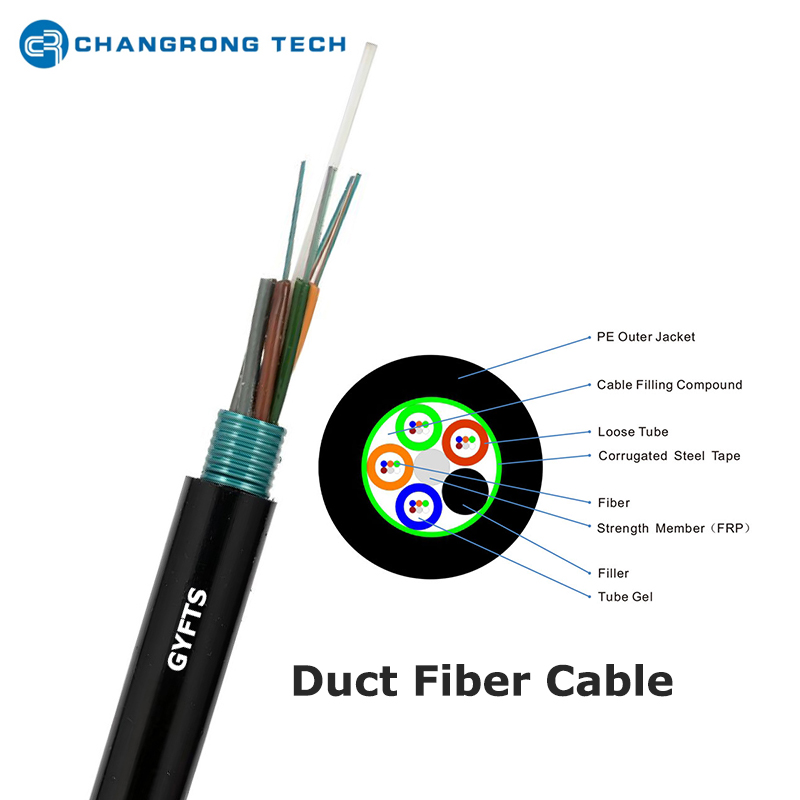
Description:
GYFTS is a standardized outdoor fiber optic cable model widely used in long-distance communication, access networks, and industrial outdoor scenarios. Its design focuses on mechanical durability, environmental resistance, and stable signal transmission, making it suitable for duct laying and aerial installation in harsh outdoor environments.
Model Definition:
GY : indicating it's designed for outdoor use.
F: referring to the loose tubes being stranded around a Non-metallic central strength member (CSM) to enhance flexibility and tensile resistance.
T:means the cable filling compound
S: denoting the armor layer is made of steel tape (for anti-rodent, anti-crush, and anti-corrosion protection).
Structure of GYFTS Fiber Optic Cable:
Central Non-Metallic Strength Member: Usually, a glass fiber reinforced plastic (FRP) rod is used as the central non-metallic strength member, which has high strength and good corrosion resistance, and can effectively enhance the tensile strength of the cable.
Optical Fiber Unit: The 9/125μm single-mode fiber or 50/125μm, 62.5/125μm multimode fiber is placed in a loose tube made of PBT, and the loose tube is filled with a water-resistant compound to protect the optical fiber from moisture.
Cable Core Structure: The loose tubes and filling ropes are stranded around the central non-metallic strength member to form a compact and round cable core, and the gaps in the cable core are filled with water-blocking fillers to ensure the overall water-blocking performance of the cable.
Armored Layer: A corrugated steel tape (PSP) is longitudinally wrapped around the cable core to form an armored layer, which can improve the cable's resistance to external pressure, impact, and rodent damage.
Outer Sheath: A polyethylene (PE) sheath is extruded outside the armored layer. The black PE sheath has good anti-ultraviolet performance, which can protect the internal structure of the cable from being damaged by sunlight and prolong the service life of the cable.
GYFTS Cable

GYFTS-24Core
Difference in structure between the model GYFTS and GYTS: Central Strength Member
| Item | GYFTS cable | GYTS cable |
| Central Strength Member | FRP (non-metallic) | Steel Wire (metallic) |
Features of GYFTS Outdoor Optical Fiber Cable:
Tensile Resistance: The central strength member (CSM) and stranded structure allow the cable to withstand tensile forces up to 1500–3000 N (depending on specifications), suitable for aerial suspension or long-distance pulling.
Crush Resistance: The steel tape armor resists radial pressure (up to 1000–2000 N/100mm), preventing fiber damage in crowded duct environments.
Rodent & Pest Resistance: Steel tape armor is impenetrable to rodents (e.g., mice, moles) and termites, avoiding costly cable breaks in underground installations.
Weather Resistance: The UV-resistant PE sheath ensures stable performance in extreme temperatures (-40°C to +70°C), suitable for high-altitude, desert, or coastal areas (resists salt spray corrosion).
Waterproof & Moisture-Proof: Loose tubes filled with water-blocking gel and optional water-swellable layers prevent moisture from entering the fiber core, avoiding signal attenuation caused by water absorption.
Chemical Resistance: HDPE sheath resists corrosion from soil chemicals (e.g., fertilizers, industrial pollutants), extending service life in industrial zones or farmland.
Low Attenuation: The loose tube design minimizes micro-bending of fibers, ensuring low signal loss (e.g., ≤0.36 dB/km at 1310nm for G.652D single-mode fibers).
High Bandwidth: Supports high-speed data transmission (up to 100 Gbps or higher for single-mode variants), meeting the needs of 5G base stations, data centers, and long-distance backbone networks.
Versatile Laying Methods: Compatible with direct burial, duct laying, and aerial installation (with additional hanging hardware), adapting to diverse outdoor scenarios.
Easy Identification: Color-coded loose tubes simplify fiber splicing and maintenance, reducing on-site work time.
Compact Design: Stranded loose tubes enable higher fiber density (up to 288 cores in a single cable) without excessive diameter, saving space in ducts.
Applications:
Deployed as trunk cables between telecom exchanges, data centers, or 5G core nodes (e.g., connecting urban and suburban base stations).
Suitable for long-distance transmission (tens to hundreds of kilometers) due to low attenuation and high mechanical strength.
Used in "last-mile" outdoor access links (e.g., from central offices to residential communities or business parks).
Directly buried or laid in ducts to connect distribution points (DP) to optical network units (ONU) in fiber-to-the-home (FTTH) projects.
Suspended between utility poles (non self-supporting aerial installation) to cover rural or remote areas where duct laying is impractical.
UV-resistant sheath ensures long service life (15–25 years) in open-air environments.
Reel Length:
normally 2km, 3km, 4km, 5km (as your request)
Drum options:
Fumigated Wooden Drum
Steel-reinforced Wooden Drum
Plywood Drum (fumigation-free)
Cable and Drum Marking according to customer's requirements.

Shipping Pictures:


