English

GYTS Outdoor Stranded Loose Tube CST Armored Underground Duct Fiber Optic Cable
| Model | GYTS |
| Fiber Counts | 2core - 288core |
| Buffer Tube | Loose Tube |
| Central Strength Member | Steel Wire |
| Waterproof | Cable Filling Compound |
| Armor | Corrugated Steel Tape |
| Outer Sheath | PE or LSZH |
| Application | Duct Installation |
| Drum Length | 2km, 3km, 4km |
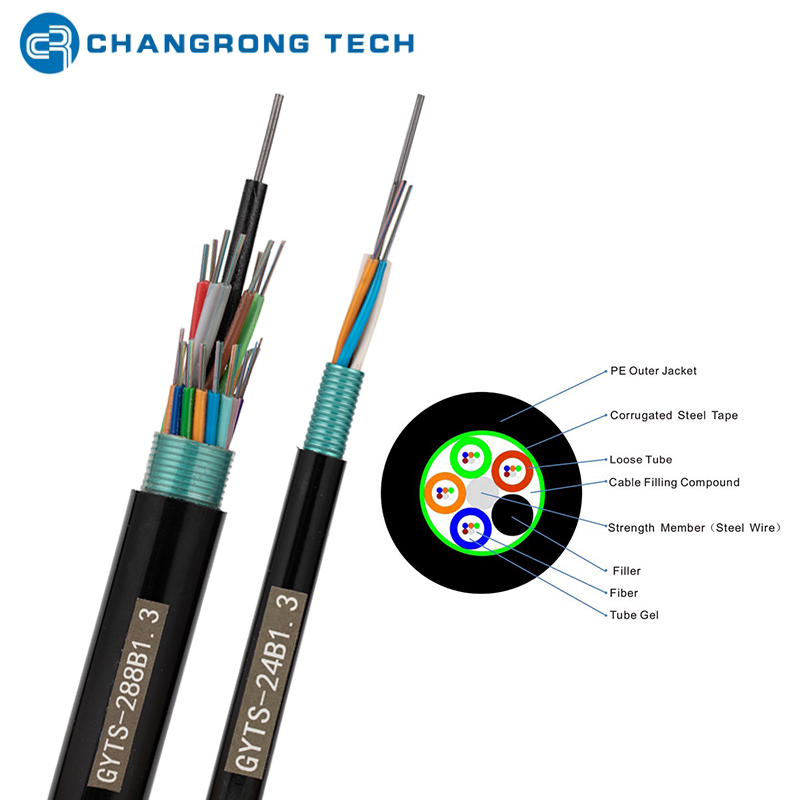
Product Overview:
GYTS cable is a widely used outdoor underground duct fiber optic cable with excellent mechanical protection and environmental adaptability. It is specifically designed for long-distance signal transmission in underground duct environments, making it a core infrastructure component in telecommunications, broadband, and industrial networks.
GYTS cables belong to the category of stranded loose tube armored fiber optic cables, optimized for underground duct deployment (non-direct burial; installed in pre-laid underground pipes). Their core function is to transmit optical signals stably over long distances while resisting external stresses (e.g., pressure, tension) and harsh underground conditions (e.g., humidity, corrosion, temperature fluctuations).
Key defining characteristics:
• Deployment scenario: Exclusive to underground ducts.
• Core structure: Stranded loose tubes to protect optical fibers, combined with CST (Corrugated Steel Tape) armor for mechanical and rodent-resistant reinforcement.
• Signal transmission: Supports single-mode (SM) or multi-mode (MM) optical fibers, compatible with modern high-speed networks (e.g., 5G, FTTx, backbone transmission).

GYTS 288core

GYTS Duct Fiber Optic Cable
Features of GYTS Optical Fiber Cable:
CST Armor Advantage: Corrugated steel tape provides superior resistance to external pressure (e.g., soil compaction, vehicle loads above ducts) and physical impact (e.g., construction accidents). It also effectively deters rodents (mice, rats) from gnawing— a common risk for unarmored cables in underground ducts.
Tension Resistance: The central steel wire strength member ensures the cable can withstand tension (up to 1.5-3 kN, depending on during installation (e.g., pulling through long ducts), preventing fiber breakage.
Inner loose tubes filled with water-blocking gel (isolates fibers directly).
Outer water-swellable tape (blocks water from spreading between layers).
This design ensures "zero water intrusion" into the fiber core, avoiding signal attenuation caused by moisture.
Stranded Loose Tube Design: Unlike "central loose tube" cables, stranded tubes allow the cable to bend more easily (minimum bending radius: 10-15× cable diameter), which is critical for navigating curved ducts or tight installation spaces.
Lightweight Relative to Direct-Burial Cables: Compared to direct-burial armored cables (e.g., GYTS53 with double steel tape), GYTS is lighter (due to single CST armor), reducing labor and equipment costs during pulling.
Temperature Resistance: Operates stably in a range of -40°C to +70°C (standard PE sheath), suitable for both cold northern regions and hot southern climates.
Corrosion Resistance: MDPE outer sheath and galvanized CST armor resist corrosion from soil chemicals (e.g., salts, acids) and groundwater, ensuring a service life of 25-30 years.
Flame-Retardant Option: LSZH outer sheath meets international standards (e.g., IEC 60332) for flame retardancy and low smoke/halogen emission, making it safe for use in tunnels, subway ducts, or urban utility corridors.
The loose tube structure minimizes micro-bending loss (signal loss caused by fiber compression). Combined with high-quality SM/MM fibers, GYTS cables support long-distance transmission:
Single-mode (G.652D): Attenuation ≤ 0.36 dB/km (at 1310 nm) and ≤ 0.22 dB/km (at 1550 nm), enabling transmission over 80-120 km without amplification.
Multi-mode (OM4): Supports 10 Gbps transmission up to 550 meters, suitable for short-distance urban access networks.
What are the main applications of GYTS Outdoor Stranded Loose tube CST armored Fiber Optic cable?
The GYTS Outdoor Stranded Loose-tube CST (Steel Tape) Armored Fiber Optic Cable is widely used in outdoor communication scenarios due to its excellent mechanical strength, waterproof performance, and UV resistance. Its core applications are mainly focused on scenarios that require stable signal transmission, resistance to harsh environmental interference, and adaptability to multiple laying methods. The main application fields are detailed below:
GYTS cables use loose-tube structures to protect fiber cores (effectively reducing microbending loss) and central metal strength members (e.g., phosphated steel wires) to withstand long-term tensile forces. These features make them ideal for long-distance trunk lines, such as connecting core communication nodes between major cities or supporting long-haul optical transmission in remote areas.
Pipeline laying: GYTS cables have a compact structure and smooth outer sheath (black PE), which can be easily pulled through pre-buried underground pipelines without being damaged by friction.
Overhead laying: The central strength member and steel tape armor enable the cable to resist wind load, ice coating, and external impacts during overhead installation (e.g., on utility poles), ensuring stable operation of the urban core network.
GYTS cables support 2–288 core counts, which can meet the demand for concurrent transmission of multiple users. Their waterproof and anti-rodent (steel tape armor resists rodent bites) properties are suitable for laying in community green belts, building basements, or outdoor access trenches, ensuring that optical signals are stably transmitted from the "backbone" to the "last mile" of user access.
The double-sided corrugated steel tape (CST) armor of GYTS cables (which model is GYTS53) can effectively resist lateral soil pressure (preventing cable deformation) and block rodent gnawing (a common risk for direct-buried cables). The full-section water-blocking structure (loose-tube filling + cable core filler) also avoids moisture intrusion, making it suitable for direct burial in farmland, woodlands, or suburban areas.
Underwater communication: For short-distance underwater laying (e.g., crossing rivers, lakes, or coastal shallow waters), their waterproof structure and corrosion-resistant PE outer sheath prevent water damage to fiber cores, supporting communication between shore-based nodes or offshore facilities.
High-humidity/UV-exposed areas: In tropical rainforests, coastal areas (high humidity, salt spray), or open areas (strong UV radiation), the black PE outer sheath of GYTS cables resists UV aging and salt spray corrosion, and the waterproof design avoids fiber attenuation caused by moisture, ensuring a service life of more than 30 years.
GYTS cables' steel tape armor and robust outer sheath can resist mechanical impacts (e.g., from construction machinery in mining areas) and reduce the impact of industrial dust/chemicals. They are often used to connect outdoor industrial control systems, power communication nodes, or oil field monitoring equipment.
Reel Length:
normally 2km, 3km, 4km, 5km (as your request)
Drum options: Fumigated Wooden Drum, Steel-reinforced Wooden Drum, Plywood Drum.
Cable and Drum Marking according to customer's requirements.

Shipping Pictures:


