English

GYTS53 Outdoor Stranded Loose Tube Double Steel Tape Armored Underground Direct Buried Fiber Optic Cable
| Model | GYTS53 |
| Fiber Counts | 2core - 288core |
| Structure | Stranded Loose Tube |
| Central Strength Member (CSM) | Steel Wire (or FRP) |
| Moisture Proof | Cable Filling Compound |
| Double Armor | Corrugated Steel Tape (CST) |
| Double Jackets (Inner & Outer) | PE (Polyethylene) |
| Application | Underground Direct Buried Laying |
| Drum Length | 2km, 3km, 4km, etc. |
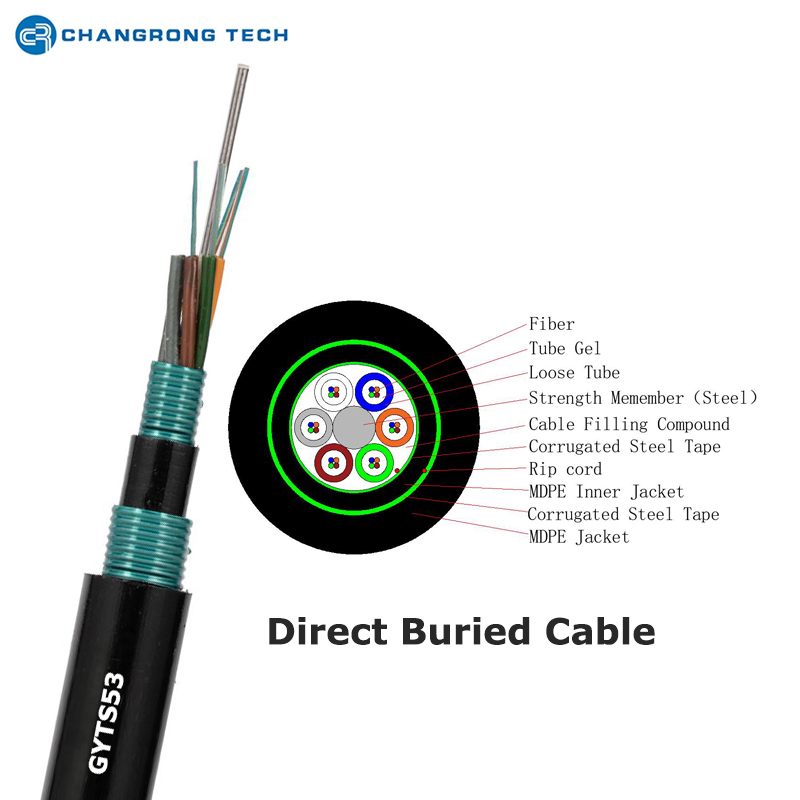
Description:
GYTS53 Double Steel Tape Armored Double Jackets Cable is a highly ruggedized outdoor fiber optic cable specifically designed for underground direct burial scenarios. It integrates multiple protective layers to resist harsh underground conditions (e.g., soil pressure, moisture, corrosion, rodent damage) while ensuring stable optical signal transmission. It is widely used in long-distance communication networks, municipal infrastructure, and industrial backhaul systems.
Its core function is to transmit optical signals over long distances (tens to hundreds of kilometers) in underground environments, with fiber counts ranging from 2 to 288 cores (common specifications: 12core, 24core, 48core, 96core, 144core) and support for both single-mode (SM, e.g., G.652D, G.657A1) and multimode (MM, e.g., OM3, OM4) fibers.
Detailed Structure of GYTS53 Double Jacket Double Armor Direct Burial Optical Fiber Cable:
The 2-288 fibers are positioned in loose tubes made of high modulus plastic and filled with gel. Tubes (and fillers) are stranded around the metallic central strength member (steel wire) to form the cable core. A Corrugated Steel Tape (CST) is longitudinally armored over the cable core, which is filled with the water-blocking compound. Then the cable core is covered with a PE inner jacket. After another Corrugated Steel Tape(CST) is longitudinally armored over the inner jacket, finally the cable is completed with a PE outer jacket.
| Layer | Component Name | Material & Specifications | Function |
| 1. | Optical Fiber Core | Single-mode (SM) or Multimode (MM) fiber | Transmit optical signals |
| 2. | Loose Tube | Polybutylene terephthalate (PBT) | Protect fibers from mechanical stress; fill with water-blocking gel to prevent moisture |
| 3. | Central Strength Member | Galvanized steel wire or fiberglass-reinforced plastic (FRP) | Resist tensile force during installation (e.g., pulling) and prevent cable deformation |
| 4. | Stranding Layer | Loose tubes stranded around the CSM (with water-blocking compound filled in gaps) | Distribute external pressure evenly; water-blocking material absorb moisture to prevent longitudinal water seepage |
| 5. | First Steel Tape Armor | Corrugated Steel Tape | Resist lateral pressure (e.g., soil compaction) and initial rodent bites |
| 6. | Inner Sheath | Polyethylene (PE) | provide basic corrosion resistance |
| 7. | Second Steel Tape Armor | Corrugated Steel Tape | Double the protection against pressure and rodent damage; enhance impact resistance |
| 8. | Outer Sheath | Medium-density polyethylene (MDPE) or HDPE (black, UV-stabilized) | Final barrier against moisture, soil chemicals (e.g., acids, alkalis), and UV radiation (if exposed temporarily) |

GYTS53 Direct Burial Cable

GYTS53 Structure
Features of GYTS53 Double CST Armored Underground Direct Buried Fibe Optic Cable:
Moisture & Water Blocking: The loose tube is filled with water-blocking gel, and the stranding layer uses water-blocking compound—effectively preventing longitudinal water seepage (a common risk in underground cables due to soil moisture or groundwater).
Corrosion Resistance: Galvanized steel tapes resist rust from soil moisture, and the PE outer sheath is inert to most soil chemicals (acids, alkalis, salts), ensuring a service life of 20–30 years.
Rodent & Pest Protection: Double steel tape armoring is hard enough to resist gnawing by rodents (e.g., rats, moles) or damage by underground insects—critical for rural or greenbelt burial areas.
Tensile Resistance: The central strength member (steel wire/FRP) and stranded structure allow the cable to withstand tensile forces of 1500–3000N (depending on fiber count), suitable for pulling during trenchless installation (e.g., horizontal directional drilling).
Lateral Pressure Resistance: Double steel tapes can bear lateral pressure of ≥10kN/100mm, preventing cable deformation or fiber breakage from soil compaction (e.g., vehicle traffic above the burial path).
Impact Resistance: The thick PE outer sheath and steel tapes absorb impact from rocks or construction equipment during installation.
The loose tube design decouples the optical fiber from external mechanical stress (e.g., bending, stretching), minimizing microbending loss (a major cause of signal attenuation).
Supports wide operating temperatures: -40°C to +70°C, adapting to extreme climates (cold northern regions or hot southern areas).
Flexible structure: The stranded loose tube design makes the cable easy to bend (minimum bending radius: 10× cable diameter for static installation, 20× for dynamic installation), suitable for narrow trenches or curved paths.
Clear identification: Loose tubes are color-coded (e.g., blue, orange, green) for quick fiber core identification during splicing or maintenance.
Applications:
Used as the "underground backbone" for telecom operators (e.g., China Mobile, AT&T) to connect cities, districts, or data centers. It transmits large-capacity signals (e.g., 5G, FTTx backhaul) over long distances with low attenuation.
Integrated into municipal projects such as road reconstruction, subway construction, or smart city networks. Buried under roads, sidewalks, or greenbelts to avoid above-ground interference (e.g., construction, weather).
Used in power grids (e.g., 110kV/220kV transmission lines) for "power communication integration" (OPGW’s underground complement). It transmits operational data (e.g., grid monitoring, relay protection signals) between substations, with steel armor resisting electromagnetic interference (EMI) from high-voltage lines.
Buried in industrial parks, mines, or oil fields to connect production facilities (e.g., factories, mining equipment). The corrosion-resistant and rodent-proof design adapts to harsh industrial environments (e.g., chemical emissions, mine soil).
Deployed in rural broadband projects (e.g., "Broadband to the Village") where above-ground poles are difficult to install. Direct burial under farmland or dirt roads reduces maintenance costs and avoids damage from wind or storms.
Color Identification (Fiber & Tube):
No. | 1 | 2 | 3 | 4 | 5 | 6 | 7 | 8 | 9 | 10 | 11 | 12 |
Color | Blue | Orange | Green | Brown | Slate | White | Red | Black | Yellow | Violet | Pink | Aqua |
Structure Parameter:
| Model | GYTS53 | ||||||||
| Fiber Type | G652D G655 G657 50/125 62.5/125 | ||||||||
| Fiber Counts | 2-30 | 32-36 | 38-60 | 62-72 | 74-96 | 98-120 | 122-144 | 146-216 | 218-288 |
| Max. fibers per tube | 6 | 6 | 12 | 12 | 12 | 12 | 12 | 12 | 12 |
| Units (Tubes or Fillers) | 6 | 6 | 5 | 6 | 8 | 10 | 12 | 18 | 24 |
| Cable Diameter(mm) | 13.0 | 13.0 | 13.3 | 13.6 | 14.9 | 16.4 | 17.6 | 17.8 | 19.7 |
| Cable Weight(Kg/km) | 184 | 184 | 189 | 204 | 241 | 281 | 316 | 320 | 389 |
| Tensile(N) | Long/Short Term:1000/3000 | ||||||||
| Crush(N/100mm) | Long/Short Term:1000/3000 | ||||||||
| Min. Bending Radius (mm) | Static/Dynamic:12.5D/25D | ||||||||
| Temperature (℃) | Storage /Operation:-40℃~70℃ | ||||||||
Fiber Parameter G.652.D (after cable):
Item | Characteristics | Unit | Value | |
Geometrical | Cladding Diameter | μm | 125.0±1.0 | |
Cladding Non-circularity | % | ≤1.0 | ||
Core-Cladding Concentricity Error | μm | ≤0.6 | ||
Core Non-circularity | % | ≤12 | ||
Coating Diameter | μm | 245±10.0 | ||
Coating-Cladding Concentricity Error | μm | ≤12 | ||
Curl Radius | m | ≥4 | ||
Attenuation | Zero Dispersion Slope S0 | ps/nm²km | ≤0.092 | |
1625nm Attenuation | dB/km | ≤0.30 | ||
1383+/-3nm Attenuation | dB/km | ≤0.36 | ||
1310nm Attenuation | dB/km | ≤0.36 | ||
1550nm Attenuation | dB/km | ≤0.22 | ||
Point Discontinuity (1310nm & 1550nm) | dB | ≤0.05 | ||
Attenuation at 1285nm ~ 1330nm compared with 1310nm | dB | ≤0.03 | ||
Attenuation at 1485nm ~1580nm compared with 1550nm | dB | ≤0.03 | ||
Zero Dispersion Wavelength λ0 | nm | 1300≤λ0≤1324 | ||
Dispersion | 1285~1339nm Dispersion | ps/nm/km | ≤3.5 | |
1271~1360nm Dispersion | ps/nm/km | ≤5.3 | ||
1550nm Dispersion | ps/nm/km | 13.3~18.6 | ||
Nominal MFD Value(1310nm) | μm | 8.6-9.5 | ||
MFD Tolerance | μm | ±0.4 | ||
Bending | Cable Cut-off Wavelength λcc | nm | ≤1260 | |
1550nm Macro-bend Induced Attenuation( 100turns with diameter of 60mm ) | dB | ≤0.5 | ||
PMD | Q | 0.01% | ||
Maximum Individual Fiber | ps/√km | 0.2 | ||
M | 20 cables | |||
Reel Length:
normally 2km, 3km, 4km, 5km (as your request)
Drum options: Fumigated Wooden Drum, Steel-reinforced Wooden Drum, Plywood Drum.
Cable and Drum Marking according to customer's requirements.

Shipping Pictures:


