English

Views: 0 Author: Site Editor Publish Time: 2026-04-15 Origin: Site
When planning modern communication networks, the decision between aerial and underground deployment has significant implications for long-term reliability, maintenance costs, and network security. While aerial fiber optic cables have traditionally been favored for their lower initial installation costs, the advantages of Underground Optical Fiber Cable are compelling for projects that demand durability, security, and decades of uninterrupted service. This comprehensive guide explores the numerous benefits of underground fiber optic deployment, comparing Direct Buried Fiber Cable and Duct Fiber Cable options, and provides data-driven insights to help you make informed infrastructure decisions in 2026.
Underground Optical Fiber Cable refers to fiber optic cables specifically engineered for installation below ground level. These cables are designed to withstand the unique challenges of subterranean environments, including soil pressure, moisture, temperature fluctuations, and mechanical threats. Within the underground category, two primary deployment methods exist:
Direct Buried Fiber Cable: Armored cables placed directly into the earth without protective conduit, relying on robust construction—typically corrugated steel tape or flat FRP anti-rodent layers—for protection against crush forces and rodent damage.
Duct Fiber Cable: Cables installed within pre-laid underground conduits or ducts, offering easier access for future upgrades or replacements while providing an additional layer of physical protection.
Both approaches offer significant advantages over aerial deployment, which this article will explore in detail.
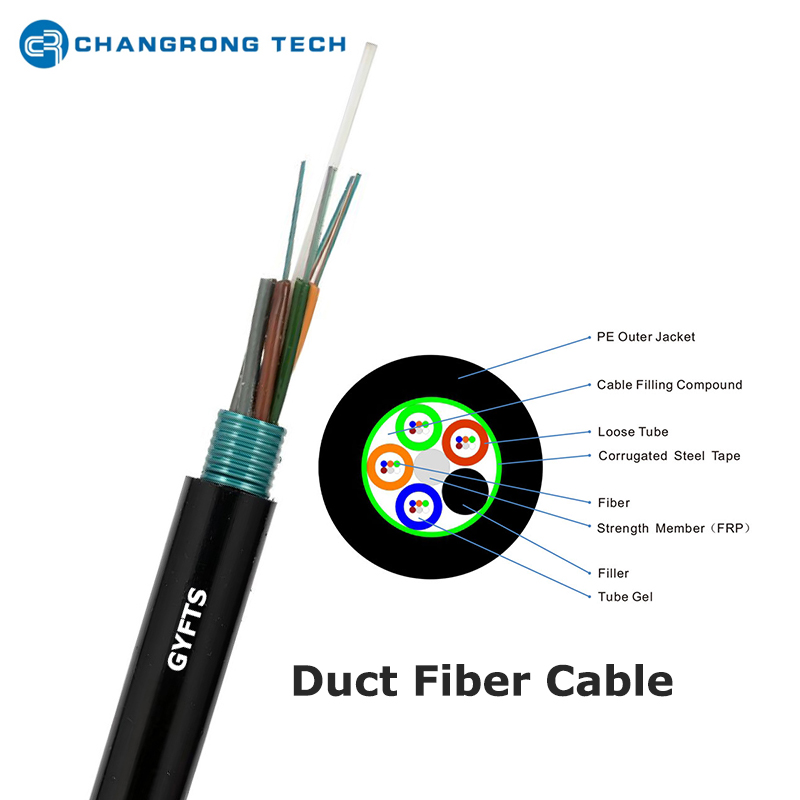
The most significant advantage of Underground Optical Fiber Cable is the exceptional physical protection it receives from the surrounding earth. Unlike aerial cables exposed to falling trees, vehicle collisions, ice storms, and wildlife, underground cables are shielded from these common hazards.
For Direct Buried Fiber Cable, the armor layer provides impressive mechanical protection:
Crush resistance up to 3000 N/100 mm for double steel tape armored designs
Rated tensile strength of 2.5 kN to 5.0 kN for installation pulls
Protection against soil settlement and shifting ground
Duct Fiber Cable, while less heavily armored than direct buried variants, benefits from the conduit’s additional protection. The combination of cable sheath and HDPE duct provides:
Resistance to excavation impacts
Protection from soil chemistry
Reduced stress during cable replacement
The protected environment of underground installation yields impressive longevity:
Typical service life: 25–30 years for properly installed Underground Optical Fiber Cable
Aerial cable lifespan: 15–20 years due to UV degradation and weather exposure
This extended lifespan translates directly to lower total cost of ownership over the network’s operational life.
Aerial fiber optic networks face constant exposure to environmental hazards that can cause frequent outages:
Hazard | Impact on Aerial Cables | Impact on Underground Cables |
|---|---|---|
Ice Storms | Cable breakage from ice loading; pole failures | None – protected by earth |
High Winds | Cable sway, fatigue, pole damage | None |
Lightning | Direct strikes damage cables and electronics | Ground provides natural shielding |
Falling Trees | Cable severance during storms | Protected |
Vehicle Collisions | Pole strikes damage aerial plant | None |
UV Radiation | Sheath degradation over time | No exposure |
Underground Optical Fiber Cable eliminates these vulnerabilities entirely. For critical infrastructure such as data center interconnects, military communications, and emergency services networks, this immunity to weather-related outages is invaluable.
Vandalism and copper theft (in hybrid cables) pose significant challenges for aerial networks. Underground Optical Fiber Cable offers superior security advantages:
Concealment: Cables are invisible and inaccessible to casual vandals
Tamper Resistance: Access requires excavation equipment and location knowledge
Theft Deterrence: Buried cables are far less attractive to thieves than aerial copper or fiber
For networks serving sensitive facilities, government installations, or high-value commercial sites, the security benefits of Direct Buried Fiber Cable or Duct Fiber Cable are often decisive factors.
Aerial fiber deployments require poles, guy wires, and visible cables that can impact community aesthetics. Underground Optical Fiber Cable eliminates visual clutter:
No utility poles or overhead lines
Preservation of scenic views and property values
Reduced wildlife impact (birds are not exposed to cable collisions)
Elimination of pole maintenance and associated herbicide use
Municipalities and residential communities increasingly mandate underground utilities for new developments, recognizing these aesthetic and environmental advantages.
While Underground Optical Fiber Cable typically requires higher upfront investment than aerial alternatives, the long-term financial picture favors underground deployment.
Cost Factor | Aerial Deployment | Underground Deployment |
|---|---|---|
Initial Installation | Lower – pole placement, cable lashing | Higher – trenching, conduit, armor |
Storm Damage Repair | Frequent – multiple events per decade | Rare – minimal weather exposure |
Vegetation Management | Ongoing – tree trimming costs | None |
Pole Maintenance | Ongoing – inspections, replacements | None |
Service Outage Costs | Higher – more frequent disruptions | Lower – superior reliability |
Insurance Premiums | Higher due to risk profile | Lower |
Total 20-Year Cost | Higher | Lower |
For Direct Buried Fiber Cable, the elimination of conduit materials reduces upfront costs compared to Duct Fiber Cable, while still providing excellent protection. For projects where future upgrades are anticipated, Duct Fiber Cable offers easier cable replacement at slightly higher initial cost.
Both deployment methods offer the core advantages of underground installation, but they serve different project needs.
Feature | Direct Buried Fiber Cable | Duct Fiber Cable |
|---|---|---|
Installation | Single pass – trench, place, backfill | Two passes – duct placement, then cable pulling |
Upfront Cost | Lower – no conduit material | Higher – conduit adds cost |
Future Upgrades | Difficult – requires new trenching | Easy – pull new cable through existing duct |
Repair Complexity | Requires excavation and splicing | Cable replacement possible without digging |
Protection Level | High – armor withstands direct soil contact | Very high – duct plus cable sheath |
Best Applications | Rural long-haul, low-upgrade areas | Urban, high-change areas, campuses |
Several converging trends in 2026 are accelerating the shift toward Underground Optical Fiber Cable:
1. AI Infrastructure Demands: Data center interconnects require maximum reliability. Hyperscale operators increasingly specify Direct Buried Fiber Cable with flat FRP anti-rodent armor for campus and metro connections.
2. Rural Broadband Expansion: Government-funded rural broadband programs favor underground deployment to avoid long-term maintenance costs associated with aerial networks in forested areas.
3. Fiber Supply Constraints: With G.652.D and G.657A2 fiber prices at seven-year highs, network operators are prioritizing long-life installations that protect their fiber investment.
4. Climate Resilience: Increasing frequency of severe weather events makes weather-resistant underground infrastructure more valuable than ever.
Successful Underground Optical Fiber Cable deployment requires consideration of local conditions:
Sandy soil: Excellent drainage, low corrosion risk
Clay soil: High moisture retention, potential for frost heave
Rocky terrain: Requires bedding layer for Direct Buried Fiber Cable
Corrosive soil: Select non-metallic armor (flat FRP) over steel tape
High water table areas require Duct Fiber Cable with watertight seals
Direct Buried Fiber Cable with gel-filled tubes provides moisture protection
Rural and agricultural areas demand flat FRP anti-rodent armor
Corrugated steel tape also provides effective rodent protection
Reliable Underground Optical Fiber Cable must pass rigorous testing to ensure decades of performance. Key tests include:
Test | Standard | Purpose |
|---|---|---|
Crush Test | IEC 60794-1-21 E3 | Verify armor withstands soil pressure |
Water Penetration | IEC 60794-1-22 F5 | Ensure water blocking integrity |
Tensile Test | IEC 60794-1-21 E1 | Confirm installation pull capacity |
Temperature Cycle | IEC 60794-1-22 F1 | Validate performance from -40°C to +70°C |
Manufacturers with CNAS-certified laboratories provide documented test results for each cable reel, ensuring compliance with specifications.
The advantages of Underground Optical Fiber Cable are clear: superior physical protection, immunity to weather-related disruptions, enhanced security, aesthetic benefits, and lower total cost of ownership over the network’s lifespan. Whether choosing Direct Buried Fiber Cable for rural long-haul applications or Duct Fiber Cable for urban environments where future flexibility is paramount, underground deployment represents the gold standard for reliable, long-lasting communication infrastructure.
For project managers and engineers seeking high-performance underground solutions, Anhui Changrong Optical Fiber & Cable Technology Co., Ltd. (CROFC) offers a full range of Underground Optical Fiber Cable products backed by extensive manufacturing expertise. Contact their engineering team for customized solutions tailored to your specific soil conditions, rodent activity levels, and performance requirements.
Q: Is Direct Buried Fiber Cable more expensive than Duct Fiber Cable?
A: No. Direct Buried Fiber Cable typically has lower total installed cost because it eliminates conduit materials and the labor required to place conduit. However, Duct Fiber Cable offers easier future upgrades, making it preferable for urban areas where network changes are frequent.
Q: How deep should Underground Optical Fiber Cable be buried?
A: Minimum depth is typically 0.8 meters (30 inches) for residential areas. Road crossings require 1.2 meters (48 inches) or more. Local codes may specify different requirements. Direct Buried Fiber Cable should always be placed with warning tape 0.3 meters above.
Q: Can Underground Optical Fiber Cable be damaged by freezing?
A: High-quality Underground Optical Fiber Cable with proper water blocking and cold-resistant sheaths is designed to withstand freeze-thaw cycles. However, frost heave in clay soils can stress cables; Duct Fiber Cable provides additional protection in these conditions.


