English

Flat FRP Armored Anti-Rodent ADSS Outdoor Aerial Fiber Optic Cable
| Model | ADSS Anti-Rodent |
| Fiber Counts | 2core - 144core |
| Fiber Type | ITU-T G.652.D |
| Central Strength Member | FRP |
| Tube | PBT Loose Tube |
| Aditional Strength Member1 | Aramid Yarn |
| Aditional Strength Member2 | Flat FRP Armor |
| Moisture Resistance | Water-Blocking Tape & Yarn |
| Inner & Outer Sheath | PE |
| Span customized | 80/100/120/150/200/300m etc. |
| Application | Self-supporting overhead laying |
| Drum Length | 2km, 3km, 4km |
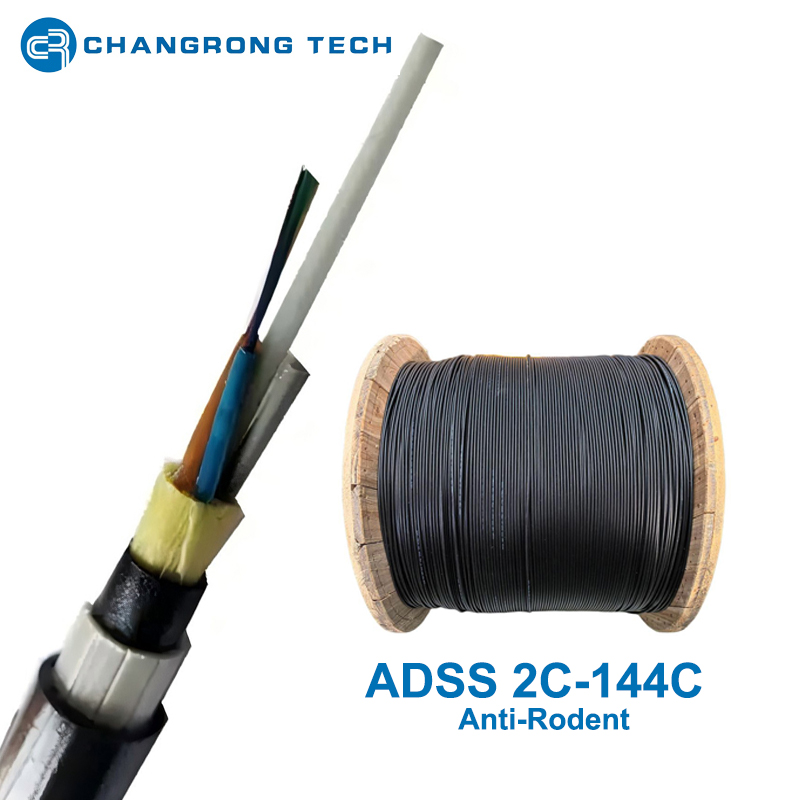
Anti-Rodent ADSS (All-Dielectric Self-Supporting) Fiber Optic Cable with Flat FRP (Fiberglass Reinforced Plastic) Armor is a specialized all-dielectric optical transmission cable designed to solve the critical problem of rodent damage (e.g., gnawing by rats, mice, squirrels) in outdoor wiring environments. It retains the self-supporting advantage of traditional ADSS cables while enhancing mechanical protection against biological threats, making it suitable for complex ecological and engineering scenarios.
The Anti-Rodent ADSS cable follows a layer-stranding design:
The fibers are positioned in the PBT loose tube filled with gel. Tubes (and fillers) are stranded around the non-metallic strength member (FRP) to form the cable core. Water blocking yarn and water blocking tape used in the cable core to prevent water penetration. Then Aramid Yarn as tensile strength member to reinforce. A PE inner sheath is extruded. After the Flat FRP embedded around longitudinally wrapped with water blocking tape. Finally, a PE outer sheath is extruded.
| Layer Name | Composition | Function |
| Fiber Core (Optical Unit) | Single-mode/multi-mode optical fibers (e.g., G.652D) | Transmit optical signals |
| Loose Tube Buffer | PBT (Polybutylene Terephthalate) | Isolates fibers from external moisture/dust; provides initial mechanical buffer. |
| Water-Blocking Layer | Water-swellable yarn + Water-blocking tape | Prevents water intrusion along the cable length |
| Strength Member | Aramid Yarn (e.g., Kevlar®), FRP (Fiber Reinforced Plastic) | Bear the cable's self-weight and tensile force (core of ADSS's "self-supporting" capability). |
| Inner Sheath | PE | Protects internal layers from corrosion and minor abrasion. |
| Flat FRP Armor Layer | FRP (Glass Fiber Reinforced Plastic) | Anti-rodent core layer: High hardness (Rockwell hardness > 80HRM) resists gnawing; flat shape optimizes installation. |
| Outer Sheath | UV-resistant PE or FR (Flame-Retardant) PE | Final protection against UV radiation, aging, chemical corrosion, and flame (for indoor scenarios). |

ADSS Anti-Rodent

ADSS Flat FRP Armored
This Fiber Optic Cable combines the advantages of ADSS, FRP armor, and anti-rodent design, with the following prominent features:
(1) Excellent Anti-Rodent Performance
Hardness Barrier: FRP armor has a surface hardness far exceeding the biting force of common rodents (e.g., rats can only gnaw materials with hardness < 60HRM). Laboratory tests show no penetration of the armor layer after 72 hours of simulated rodent gnawing.
Non-Toxic & Non-Attractive: Unlike metal armor (which may attract rodents), FRP is inert and does not emit odors that lure pests, reducing long-term damage risks.
(2) All-Dielectric Advantage
No metal components (e.g., steel wire, aluminum tape) avoid electromagnetic interference (EMI) from high-voltage power lines, ensuring stable signal transmission for power system communication (e.g., SCADA, relay protection).
Eliminates the risk of electric shock during installation/maintenance, making it safe for use in 110kV–500kV transmission line corridors.
(3) Strong Mechanical Properties
Self-Supporting: Aramid strength members enable the cable to span 50–200 meters between poles/towers without additional support, reducing engineering costs.
Abrasion & Impact Resistance: FRP armor enhances resistance to external friction (e.g., from tree branches, duct walls) and moderate impact (e.g., falling debris), extending service life to 20–30 years.
(4) Environmental Adaptability
Corrosion Resistance: FRP and LSZH materials resist acid/alkaline soil, salt spray (coastal areas), and chemical pollutants (industrial zones), avoiding rust issues of metal-armored cables.
UV & Temperature Resistance: The outer sheath's UV stabilizers withstand long-term outdoor exposure; the cable operates stably in a wide temperature range (-40°C to +70°C), suitable for cold plateaus and hot regions.
(5) Easy Installation & Compatibility
Flat Design: The flat cross-section (typically 8–12mm thick, 20–30mm wide) fits into narrow ducts, wall-mounted brackets, or cable trays, saving space compared to round armored cables.
Lightweight: FRP is 1/4 the density of steel, so the cable is lighter than metal-armored ADSS, reducing load on poles/towers and simplifying manual handling.
The ADSS Flat FRP Armored cable is ideal for scenarios where rodent activity is frequent and all-dielectric/self-supporting performance is required:
Transmission Line Corridors: Used for communication between substations and power plants, especially in rural or suburban sections where rodents (e.g., field mice) are active.
Distribution Network Cabling: Laid along utility poles in residential areas, preventing rodent damage to power monitoring and control signals.
Rural FTTH (Fiber-to-the-Home): Deployed in village streets or farmland, avoiding gnawing by rats in soil or vegetation.
Industrial Parks: Used in factory internal networks (e.g., between workshops), where FRP armor resists both rodents and industrial dust/chemicals.
Railway/Highway Side Cabling: Laid along railway tracks or highway guardrails, protecting against rodents in roadside green belts and withstanding vibration from passing vehicles.
Forestry & Ecological Areas: Used in forest fire monitoring or ecological data transmission systems, where FRP's non-metallic property avoids interference with wildlife and resists gnawing by squirrels.
Ordinary ADSS: Only aramid yarn for tensile strength, no anti-rodent barrier; easily bitten through by rats, squirrels and field rodents.
Flat FRP armored ADSS: Hard flat FRP rods block rodent gnawing completely, still fully dielectric without any metal; flat structure brings better duct & wall-mount adaptability while retaining long-span self-supporting aerial performance.
Flat FRP rods: Thin, flat profile, smaller overall cable dimension, lighter weight, easier to bend and install in narrow troughs, ducts and pole brackets; fully dielectric, no EMI risk near high-voltage power lines.
Round FRP armor: Larger cable outer diameter, occupies more laying space.
Steel tape armor: Metal material will induce electromagnetic coupling under high-voltage lines, causing discharge risk and signal interference; steel rusts in coastal, acid/alkaline environments and shortens service life.
Light load area (no icing): 50–150m conventional span
Heavy ice & strong wind region: 30–80m span
We can customize aramid yarn strength to meet customer specific span requirements.
HDPE UV-resistant sheath: Standard outdoor aerial use, anti-UV, anti-aging, cost-effective for overhead power corridors, rural FTTH aerial lines.
LSZH low smoke zero halogen sheath: For tunnels, urban overhead close to residential buildings, underground ducts, fire safety required projects; low smoke and non-toxic when burning.
Flame retardant PE sheath: Industrial parks, factory overhead wiring.
CROFC Anti-Rodent ADSS with Flat FRP Armor fills the gap between traditional ADSS cables (poor anti-rodent performance) and metal-armored cables (electromagnetic interference, heavy weight). Its layered structure, all-dielectric design, and flat FRP armor make it a cost-effective, reliable solution for optical transmission in rodent-prone, complex environments—especially in power, urban, and rural communication networks.
| Model | Anti-Rodent ADSS | ||||||||
| Fiber Type | G652D G655 G657 50/125 62.5/125 | ||||||||
| Fiber Counts | 2-30 | 32-36 | 38-60 | 62-72 | 74-96 | 98-120 | 122-144 | 146-216 | 218-288 |
| Max. fibers per tube | 6 | 6 | 12 | 12 | 12 | 12 | 12 | 12 | 12 |
| Units (Tubes or Fillers) | 6 | 6 | 6 | 6 | 8 | 10 | 12 | 18 | 24 |
| Cable Diameter(mm) | 13.8 | 13.8 | 15.0 | 15.0 | 16.5 | 18.0 | 19.5 | 19.7 | 22.0 |
| Cable Weight(Kg/km) | 175 | 175 | 210 | 210 | 255 | 295 | 356 | 354 | 432 |
| Tensile(N) | Long/Short Term:2500/5000 | ||||||||
| Crush(N/100mm) | Long/Short Term:1000/3000 | ||||||||
| Min. Bending Radius (mm) | Static/Dynamic:15D/30D | ||||||||
| Temperature (℃) | Storage /Operation:-40℃~70℃ | ||||||||
Item | Value | |||
Span | 300 M | |||
Fiber Count | 12 | 24 | 48 | 144 |
PBT Tube | 1 | 2 | 4 | 12 |
Fiber Count/ Tube | 12 | 12 | 12 | 12 |
Filler | 6 | 5 | 3 | 0 |
OD of Tube/mm | 2.0±0.1 | 2.0±0.1 | 2.0±0.1 | 1.9±0.1 |
Thickness of Tube/mm | 0.30±0.05 | 0.30±0.05 | 0.30±0.05 | 0.30±0.05 |
Central Strength FRP | 2.8 | 2.8 | 2.8 | 2.8 |
Coated FRP | - | - | - | 5.6 |
Water Blocking Material | Water Blocking Yarn+Water Blocking Tape | |||
Rip cord | Polyester yarn*2 | |||
Water Blocking Material | Water Blocking Yarn+Water Blocking Tape | |||
Inner Sheath | Nominal Thickness 1.0mm HDPE | |||
Peripheral Strength Member | Aramid Yarn | |||
Rip cord | Polyester yarn*2 | |||
Middle Sheath | Nominal Thickness 1.0mm HDPE | |||
Armor | Flat FRP 3.0*1.0mm | Flat FRP 3.0*1.0mm | ||
Water Blocking Material | Water Blocking Yarn+Water Blocking Tape | |||
Rip cord | Polyester yarn*2-Red | |||
Outer Sheath | Nominal Thickness 2.0mm HDPE | Nominal Thickness 2.0mm HDPE | Nominal Thickness 2.0mm HDPE | Nominal Thickness 2.0mm HDPE |
OD of Cable/mm | 17.8±0.3 | 17.8±0.3 | 17.8±0.3 | 20.5±0.3 |
Weight | 294kg/km | 294kg/km | 297kg/km | 392kg/km |
Item | Characteristics | Unit | Value | |
Geometrical | Cladding Diameter | μm | 125.0±1.0 | |
Cladding Non-circularity | % | ≤1.0 | ||
Core-Cladding Concentricity Error | μm | ≤0.6 | ||
Core Non-circularity | % | ≤12 | ||
Coating Diameter | μm | 245±10.0 | ||
Coating-Cladding Concentricity Error | μm | ≤12 | ||
Curl Radius | m | ≥4 | ||
Attenuation | Zero Dispersion Slope S0 | ps/nm²km | ≤0.092 | |
1625nm Attenuation | dB/km | ≤0.30 | ||
1383+/-3nm Attenuation | dB/km | ≤0.36 | ||
1310nm Attenuation | dB/km | ≤0.36 | ||
1550nm Attenuation | dB/km | ≤0.22 | ||
Point Discontinuity (1310nm & 1550nm) | dB | ≤0.05 | ||
Attenuation at 1285nm ~ 1330nm compared with 1310nm | dB | ≤0.03 | ||
Attenuation at 1485nm ~1580nm compared with 1550nm | dB | ≤0.03 | ||
Zero Dispersion Wavelength λ0 | nm | 1300≤λ0≤1324 | ||
Dispersion | 1285~1339nm Dispersion | ps/nm/km | ≤3.5 | |
1271~1360nm Dispersion | ps/nm/km | ≤5.3 | ||
1550nm Dispersion | ps/nm/km | 13.3~18.6 | ||
Nominal MFD Value(1310nm) | μm | 8.6-9.5 | ||
MFD Tolerance | μm | ±0.4 | ||
Bending | Cable Cut-off Wavelength λcc | nm | ≤1260 | |
1550nm Macro-bend Induced Attenuation( 100turns with diameter of 60mm ) | dB | ≤0.5 | ||
PMD | Q | 0.01% | ||
Maximum Individual Fiber | ps/√km | 0.2 | ||
M | 20 cables | |||

Reel Length:
normally 2km, 3km, 4km (as your request)
Drum options:
Fumigated Wooden Drum
Steel-reinforced Wooden Drum
Plywood Drum
Cable and Drum Marking according to customer's requirements.

Shipping Photos: