English

Views: 0 Author: Site Editor Publish Time: 2026-07-08 Origin: Site
The hardest part of choosing fiber for an FTTH Drop Fiber Optic Cable is not always the optical specification on paper, but the route the cable must survive after installation. A short drop link may still pass through wall boxes, risers, ducts, tight corners, and the final area near the optical network terminal. That is where the difference between G652D, G657A1, and G657A2 becomes practical: G652D suits straighter protected paths, while G657A1 and G657A2 provide better bend tolerance for space-limited FTTH routing.
G652D has been one of the most widely deployed single-mode fibers because of its mature technology, stable transmission characteristics, and broad compatibility. It remains an excellent choice for applications where cable routing is relatively straight and installation conditions are predictable.
The main limitation of G652D appears when the cable needs to handle tight bending. During FTTH installation, drop cables are often routed through corners, compact distribution boxes, or areas behind customer equipment. When a standard single-mode fiber is bent beyond its recommended conditions, part of the optical signal may escape from the core, increasing bending-related attenuation.
This does not mean G652D is unsuitable for FTTH networks. In many network designs, it can still be used effectively in feeder sections, outdoor duct routes, and areas where sufficient bend radius can be maintained. The key consideration is not whether the fiber is old or new, but whether the installation environment matches its characteristics.
For projects with straight cable paths and controlled construction conditions, G652D remains a practical and economical option. However, using it in highly compact subscriber-side locations may increase installation challenges because installers have less flexibility when routing the cable.
G657A1 was developed to provide better bending performance while maintaining compatibility with existing single-mode fiber systems. Compared with G652D, it gives installers more flexibility when cables need to pass through moderate bends or smaller installation spaces.
This makes G657A1 suitable for many building access scenarios, including corridor routing, vertical risers, building entrances, and distribution points where the cable path contains several turns but does not require extremely small bending radii.
The advantage of G657A1 is its balance. It improves installation tolerance without necessarily requiring the highest bend-performance level. For projects where cable routes are planned and installers can control the installation process, G657A1 can provide sufficient protection against common bending issues while maintaining cost efficiency.
In many FTTH deployments, G657A1 works as a transition solution between outdoor network sections and indoor subscriber connections. It provides additional flexibility while remaining suitable for integration with existing fiber infrastructure.
G657A2 is designed for environments where bending conditions are more demanding. Compared with G652D and G657A1, it provides stronger resistance against signal loss caused by tight bends, making it particularly suitable for modern FTTH drop cable applications.
Subscriber-side installation is often the most challenging part of the network. The cable may need to fit into small wall outlets, pass around furniture, enter compact terminal boxes, or be repositioned by users after installation. Under these conditions, additional bend tolerance can significantly improve long-term reliability.
The value of G657A2 is not only during initial construction. It also reduces the risk of future service problems caused by accidental cable bending or limited installation space. G657A1 and G657A2 both improve macrobending control, but G657A2 offers a stronger margin for tighter and less predictable routing conditions.
For a bend-resistant FTTH Drop Fiber Optic Cable used in limited indoor space, G657A2 is often the safer choice because it provides more installation flexibility when routing is difficult to predict.
Fiber Type | Main Advantage | Main Limitation | Best Use in FTTH Drop Cable |
G652D | Mature, economical, stable in straight routes | More sensitive to tight bending | Protected duct routes, feeder-side sections, low-bend installations |
G657A1 | Balanced bend tolerance and compatibility | Less bend margin than G657A2 | Building entry, risers, corridors, moderate indoor bends |
G657A2 | Strongest bend performance among the three | Higher specification than some simple routes require | Indoor drop, wall plates, compact boxes, tight corners |
The main difference between these fibers is not basic transmission ability but how they respond to installation stress. In many FTTH applications, the cable length is limited, so the accumulated effect of multiple bends becomes more important than long-distance attenuation.
A common mistake is comparing fibers only by optical loss values. While attenuation remains an important specification, the actual installation environment often determines whether the network operates reliably. A fiber that experiences repeated sharp bends may suffer more practical performance problems than one installed in a longer but straighter route.
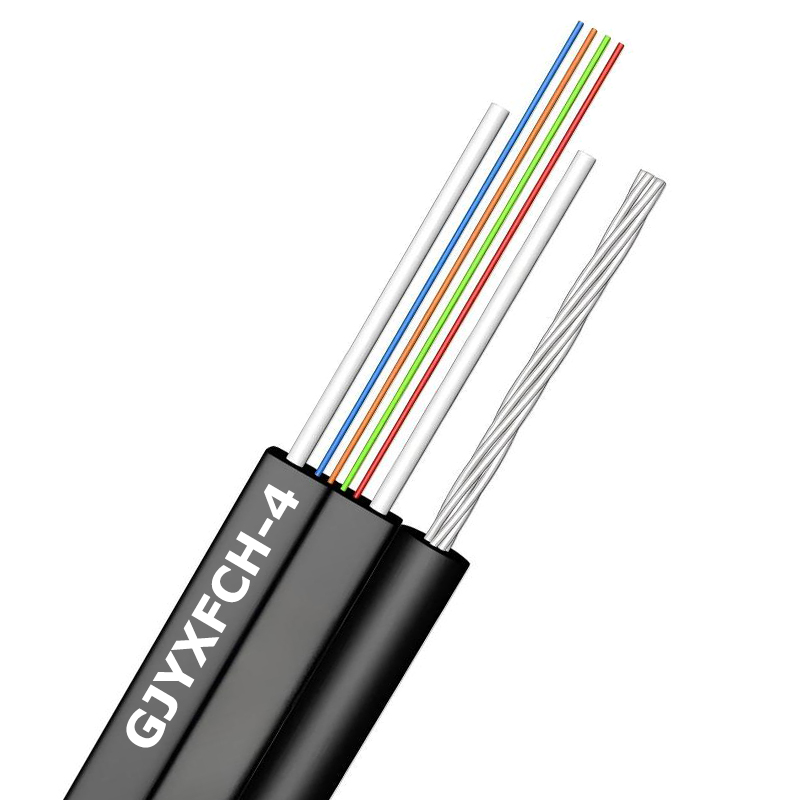
CR’s FTTH drop cable product range includes different structures such as GJYXCH, GJYXFCH, GJXH, GJXFH, and GJYXFHS, with fiber options including G657A1 and G657A2 for last-mile applications.
Indoor FTTH cabling usually involves more complex routing than expected. The cable may travel along walls, pass through corners, enter indoor distribution boxes, and connect directly to customer terminals. These routes create multiple opportunities for bending stress.
For an indoor FTTH Drop Fiber Optic Cable, bend resistance becomes a major factor because installers often need lightweight and flexible cables that can fit into residential spaces. G657A1 and G657A2 fibers are commonly preferred because they maintain better optical performance when the cable is installed in compact areas.
CR’s GJXFH indoor bow-type FTTH drop cable is designed for indoor fiber-to-the-home applications. It supports G652D, G657A1, and G657A2 fiber options, uses two FRP non-metallic strength members, and applies an LSZH sheath for indoor installation requirements.
The cable structure and fiber selection work together. The FRP strength members provide mechanical support, while the G657 fiber options improve resistance against bending-related signal loss. This combination makes indoor drop cable easier to install in areas such as apartments, offices, and buildings where space is limited.
Outdoor-to-indoor transition points create different challenges. In these locations, cables may face moisture, pressure, pulling forces, and environmental exposure. Armored duct drop cables are designed to provide additional mechanical protection in these situations.
However, mechanical protection and bending performance solve different problems. Armor layers can improve resistance against external damage, but they do not automatically make the optical fiber more tolerant of tight bends.
CR’s GJYXHS/GJYXHA armored duct drop cable is an example of a duct-introduction FTTH cable structure. It supports G652D, G657A1, and G657A2 fiber types and includes features such as steel wire strength members, water-blocking tape, steel or aluminum armor layers, and LSZH or PE outer sheaths.
When selecting the fiber inside an armored drop cable, engineers still need to evaluate the actual route. A protected but narrow duct may still benefit from G657A1 or G657A2, while a larger and straighter pathway may allow the use of G652D.
G652D, G657A1, and G657A2 are not competing technologies that must be used separately. Modern FTTH networks often combine different fiber types according to their position in the network.
G657 Category A fibers are designed to maintain compatibility with G652-based systems, allowing them to be deployed in access networks where existing infrastructure uses G652D fiber.
A common network approach is using G652D in feeder or distribution sections where cable routes are longer and relatively stable, then using G657A1 or G657A2 closer to the subscriber side where bending requirements become stricter.
Compatibility makes network upgrades easier, but it does not eliminate the need for correct fiber selection. A compatible fiber is not automatically the best choice for every installation environment.
Cost is always an important consideration in large-scale FTTH projects. G652D generally benefits from mature production and widespread availability, making it attractive for applications where bending is not a major concern.
However, choosing a lower-cost fiber for a difficult installation environment may increase construction problems and maintenance requirements. In compact residential deployments, the additional flexibility of G657A2 can provide practical value.
The right comparison should consider the total project cost, including installation difficulty, potential repair work, and long-term reliability.
● Choosing G652D only because it is widely used, even when the route contains many tight bends.
● Selecting G657A2 for every application without considering whether the additional bend performance is necessary.
● Assuming armored cable completely eliminates fiber bending concerns.
● Comparing only material price while ignoring installation and maintenance factors.
The most suitable fiber depends on the actual cable route:
● Choose G652D for straight, protected, low-bend routes where cost efficiency is a priority.
● Choose G657A1 for moderate indoor bending conditions such as building entry points, risers, and planned corridor routes.
● Choose G657A2 for compact indoor routing, wall plates, ONT-side connections, and subscriber-side areas with unpredictable bending.
For indoor bow-type FTTH drop cables, G657A1 or G657A2 is usually preferred when the cable needs to pass through corners, narrow spaces, or terminal areas.
For armored duct drop cables, the fiber choice should be based on both mechanical protection requirements and bend conditions. Armor protects the cable from external stress, while the fiber type determines how well optical performance is maintained during routing.
For projects where multiple fiber options are available within the same cable structure, the final decision should always follow the installation environment rather than selecting a fiber only by specification level.
G652D, G657A1, and G657A2 should be selected according to the real cable path, not only the fiber name. G652D fits straighter protected sections, G657A1 gives useful margin for moderate indoor bends, and G657A2 is more suitable for tight subscriber-side routing near wall plates, boxes, and terminals. For buyers choosing an FTTH Drop Fiber Optic Cable, Anhui Changrong Optical Fiber & Cable Technology Co., Ltd. offers drop cable options for indoor, duct, and outdoor access needs, helping projects match fiber performance with installation conditions and long-term reliability.
A: G657A1 or G657A2 is usually preferred because FTTH drop routes often include bends around corners, wall plates, small boxes, and ONT connection areas.
A: G652D is a standard single-mode fiber for straighter routes, while G657 fibers are bend-insensitive and better suited for tighter indoor or access-network cabling.
A: Not always. G657A2 offers stronger bend tolerance, but G657A1 can be enough for planned indoor routes with moderate bends and controlled installation conditions.
A: Yes. G657 Category A fibers are generally compatible with G652D-based networks, so they can be combined across feeder, distribution, and drop cable sections.
A: Yes, when the route includes tight bends. Armor improves mechanical protection, but the fiber type still determines resistance to bend-related optical loss.
A: G652D can be used where the route is straight, protected, and low-bend, such as feeder-side sections or duct paths with enough bending clearance.


