English

Views: 0 Author: Site Editor Publish Time: 2026-06-10 Origin: Site
In many FTTH projects, the network reaches the building long before the final subscriber connection is truly solved. The last short cable still has to pass through walls, ducts, corridors, entry holes, and tight corners without adding signal loss or creating maintenance problems. An FTTH Drop Fiber Optic Cable is designed for this final access section, where flexibility, bend resistance, sheath material, and installation route matter more than fiber count alone. Understanding its structure and use cases helps buyers choose the right cable for indoor wiring, duct routes, or aerial entry.
The drop cable sits at the user end of the FTTH network. A simple route can be understood as: fiber distribution box or optical distribution point, then drop cable, then ONU, ONT, or indoor wall outlet. Feeder cables and distribution cables are designed for broader network transport, while the final access cable must work in smaller spaces and closer to users. That is why an FTTH Drop Fiber Optic Cable is usually compact, low in fiber count, and easier to handle than larger outdoor backbone cables.
This final section may look short compared with the rest of the optical network, but it directly affects the user’s service experience. If the cable is crushed, bent too tightly, poorly fixed, or exposed to the wrong environment, the optical signal can become unstable before it even reaches the terminal equipment. A good last-mile cable is not just a physical connection; it is the part that allows a planned FTTH network to become a working service inside a real building. The selection should therefore begin with the route between the distribution point and the user equipment, not only with the cable model name.
User-side routing creates stresses that ordinary fiber cable may not handle efficiently. Installers often need to pass the cable through door frames, wall holes, conduits, cable trays, skirting routes, or tight corners near terminal boxes. During this process, the cable may be pulled, clipped, coiled, opened for termination, and adjusted several times. A standard cable that is too large or difficult to strip can slow down installation and increase the chance of fiber damage.
The most useful properties in this section are flexibility, bend performance, simple access to the fiber, and a jacket suited to the route. High fiber count is usually less important for a single home connection than clean handling and reliable optical performance after installation. This is why FTTH drop designs often use bend-insensitive single-mode fiber and compact bow-type or figure-8 structures. In practical terms, the cable should help the installer finish a clean route without creating hidden signal-loss points.
The optical fiber inside the cable carries the light signal, so its bend performance matters strongly in FTTH access routes. Most FTTH drop cables use single-mode fiber, commonly including G.657A1 or G.657A2, because the final indoor or building-entry section often includes tighter bends than long outdoor runs. G.657 fibers are designed for access networks where bending-loss performance is especially important, making them suitable for routes with limited space and frequent direction changes.
G.652D is still widely used in standard single-mode transmission environments, but G.657 fibers are more suitable when routing conditions are more restrictive. The practical difference is not that one fiber is “good” and the other is “bad”; it is about where the cable will be installed. A route with long, straight duct sections may not need the same bend performance as an apartment corridor or room entry with small turns. Indoor bow-type FTTH drop cable options commonly include G652D, G657A1, and G657A2 fiber choices so the cable design can match different routing needs.
Strength members protect the optical fiber from pulling force, fixing pressure, and routing stress. In a drop cable, the fiber itself should not carry the mechanical load during installation. Steel wire strength members are useful where stronger mechanical support is needed, especially when the cable may face more pulling or tension. FRP strength members are non-metallic and lightweight, making them suitable where dielectric protection, easier handling, or corrosion resistance is preferred.
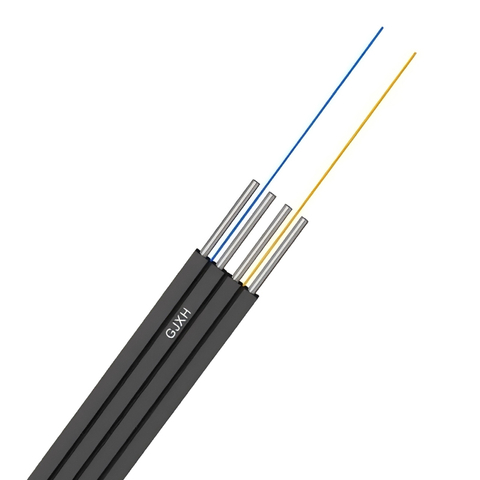
The choice between steel wire and FRP should follow the installation environment. Indoor routes may use steel wire when stronger support is needed in a compact structure, while FRP is often chosen for non-metallic cable designs. A compact indoor option such as CROFC GJXH uses a 2.0 × 3.0 mm bow-type structure with two steel wire strength members and an LSZH jacket for routing from a building optical distribution point to user terminals.
The outer jacket protects the cable from the surrounding environment. For indoor routes, LSZH is commonly preferred because low-smoke, zero-halogen materials support safer building wiring where flame-retardant and low-smoke behavior is important. For outdoor, duct, or semi-exposed routes, PE or HDPE-type jackets are often selected for better resistance to moisture, UV exposure, abrasion, and weather-related wear. The jacket should be chosen according to the harshest section of the route, not simply according to a general cable label.
This distinction becomes important when a cable moves from outdoors to indoors. A route may begin at an outdoor distribution point, pass through a wall, and continue into a user space. In that case, the cable may need both environmental resistance and indoor safety suitability, or the route may require a controlled transition at the entry point. Selecting the jacket correctly helps prevent a common mistake: using an indoor cable where moisture, sunlight, or mechanical exposure are the real risks.
Indoor bow-type cable is one of the most common choices for short FTTH building routes. It is used in homes, apartments, offices, hotels, corridors, and floor distribution box-to-user terminal connections. The flat bow-type or butterfly profile helps installers route the cable neatly along walls or through small indoor pathways. Its compact structure also supports easier stripping and field termination, which is valuable when many user connections must be completed efficiently.
This cable type is suitable when the route is mainly indoors and does not face heavy moisture, long aerial span tension, or severe mechanical exposure. For indoor wiring, choosing a flexible FTTH Drop Fiber Optic Cable helps support clean routing, bend performance, jacket safety, and reliable termination. CROFC GJXH is a typical indoor bow-type option that combines a compact 2.0 × 3.0 mm structure, steel wire strength members, and an LSZH jacket for indoor FTTH connection from distribution point to user equipment.
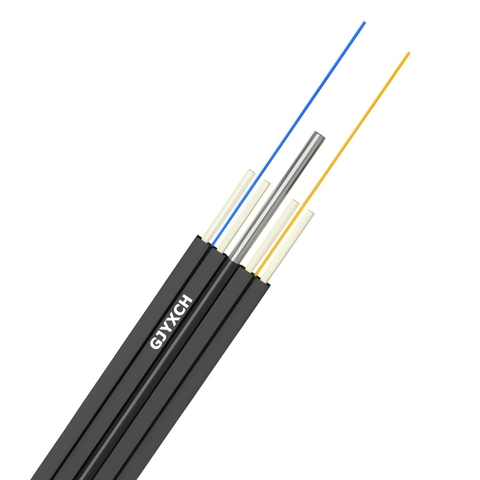
Armored duct drop cable is more suitable when the route includes duct sections, basements, semi-outdoor pathways, short buried sections, rodent-prone areas, or places where the cable may face pressure and abrasion. In these situations, a standard indoor bow-type cable may be too lightly protected, while an armored FTTH Drop Fiber Optic Cable is more suitable for routes with moisture, crush, rodent, or abrasion risk. Armor is not added just to make the cable look stronger; it is used when the installation path creates a real risk of moisture, crush, rodent damage, or rough handling. The key selection logic is whether the cable needs stronger mechanical and environmental protection.
CROFC GJYXFHS / GJYXFHA armored duct bow-type cable fits this type of route. The structure includes a GJXFH cable core, FRP strength members, water-blocking tape, aluminum or steel tape armor, and LSZH or PE sheath options. This makes it more appropriate for FTTH drop routes that need duct protection while still remaining close to the familiar bow-type access cable structure.
Self-supporting drop cable is used when the last-mile route includes an aerial span, such as a connection from a pole to a building or between nearby structures. The figure-8 or messenger-wire design gives the cable additional support so that the optical cable body is not forced to carry the full span tension. This type is different from duct cable because the main issue is not conduit pressure or moisture alone, but outdoor suspension, wind movement, fixing points, and pulling load. The support element helps the cable maintain a stable route before it enters the building.
CROFC GJYXFCH self-supporting mini figure-8 FTTH drop cable uses a steel messenger wire with FRP strength members for last-mile aerial deployment from distribution points to end-user premises. Another outdoor figure-8 option combines a steel messenger wire with steel wire strength members in a compact aerial structure for outdoor last-mile access. These examples show how aerial entry requires a cable direction that is different from indoor room routing or protected duct installation.
Installation path | Better cable direction | Main reason |
Indoor wall, corridor, or room routing | Indoor bow-type drop cable | Flexible, compact, easy to strip |
Duct, basement, or exposed pathway | Armored duct drop cable | Better moisture and mechanical protection |
Pole-to-house or outdoor aerial entry | Self-supporting drop cable | Messenger support for pulling tension |
Choosing the right FTTH Drop Fiber Optic Cable depends on the actual last-mile route, not only on fiber count or cable size. Indoor wiring, duct pathways, aerial entry, and outdoor-to-indoor transitions each require different levels of bend performance, tensile support, jacket protection, and installation flexibility. Anhui Changrong Optical Fiber & Cable Technology Co., Ltd. provides FTTH drop cable options for these route conditions, including indoor bow-type, armored duct, and self-supporting designs, helping buyers match cable structure to real installation needs and reduce avoidable signal loss or maintenance issues.
A: An FTTH Drop Fiber Optic Cable is the final cable segment that connects a fiber distribution point to a home, office, ONU, ONT, or wall outlet.
A: FTTH drop cable is used for last-mile fiber access, carrying internet, voice, and video signals from the optical distribution network to the subscriber’s premises.
A: Yes, but outdoor use requires the right structure, such as UV-resistant sheath, water-blocking protection, armor, or a self-supporting messenger for aerial installation.
A: Indoor cable usually focuses on flexibility, easy stripping, and LSZH safety, while outdoor cable needs stronger moisture, sunlight, abrasion, and tensile protection.
A: Tight bending can increase signal loss or damage the fiber. Bend-insensitive fiber helps, but installers still need to follow the cable’s bending limits.
A: Start with the route. Indoor wiring, duct pathways, aerial entry, and outdoor-to-indoor transitions require different fiber types, strength members, jackets, and protection levels.


