English

Views: 0 Author: Site Editor Publish Time: 2026-07-01 Origin: Site
A last-mile fiber route can look simple on a drawing, but the final drop often decides how smoothly the service is installed and maintained. The same FTTH Drop Fiber Optic Cable may face very different conditions depending on whether it is pulled through a duct, suspended from a pole, clipped along a wall, or transitioned indoors near the subscriber’s entry point. Duct routes offer protection and cleaner appearance, while aerial routes often save time when supports already exist. Understanding these differences helps buyers choose a cable structure that matches real installation conditions, not just a product name.
Duct installation places the FTTH Drop Fiber Optic Cable inside a conduit, microduct, wall sleeve, or another protected pathway before it reaches the user side. This route reduces direct exposure to wind, sunlight, falling branches, and accidental outdoor contact. In residential communities or commercial buildings, the cleaner appearance of duct routing can also be an important advantage because the cable is not visibly stretched across open space.
Protection, however, does not mean the route can be ignored. Duct space, bend points, pulling distance, moisture conditions, and access points should be checked before the cable model is selected. A narrow or crowded conduit may create high friction during pulling, while a route with several tight bends can increase stress near the building entry. If the duct is blocked, crushed, or poorly documented, even a good cable may become difficult to replace later.
For this reason, duct routing is not automatically the better option. It is better when the pathway is usable, accessible, and planned with future maintenance in mind. Buyers should evaluate the whole route instead of assuming that every protected pathway will provide easy installation.
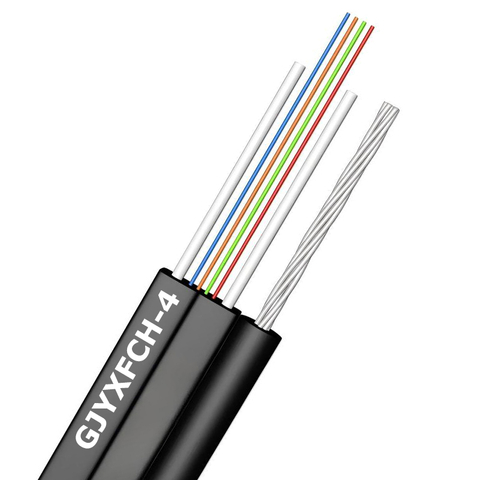
Aerial drop installation suspends the cable between poles, building walls, outdoor brackets, or other support points. This method is common in last-mile FTTH projects because it can reduce excavation work and shorten activation time. When poles or exterior supports are already available, the installer can often complete the drop more quickly than a duct route that requires conduit inspection, pulling preparation, or civil work.
The trade-off is exposure. An aerial FTTH Drop Fiber Optic Cable must handle sunlight, rain, wind, temperature changes, and possible contact with trees or exterior objects. The cable is easier to inspect visually, but it is also more visible and more exposed to environmental damage.
This is why aerial drop cables need a support structure. CROFC’s GJYXCH uses a self-supporting figure-8 structure, combining a steel messenger wire with the cable body for outdoor last-mile deployment. GJYXFCH follows a similar aerial self-supporting concept, using a steel messenger wire with FRP strength members for last-mile FTTH connection from distribution points to user premises.
Aerial installation usually has the advantage when existing poles, exterior walls, or support hardware are already available. The route does not require trenching, surface restoration, or long conduit preparation. For short pole-to-house drops, this can make aerial deployment faster and more economical than building a new duct route.
The saving is not only about cable price. Labor time, route preparation, and access equipment often matter more than the cost of the cable itself. If a service provider needs to connect many homes in a rural or suburban area, aerial drops can help shorten installation time because crews can work along visible routes.
Even so, aerial installation should not be chosen only because it looks simple. Pole condition, span length, fastening hardware, clearance requirements, and local installation rules can affect the final cost. A weak support point or an overly long span may require extra hardware or a different cable structure. The best aerial route is one where the supports are ready, the span is reasonable, and the exposure risks are acceptable.
Duct installation may take more preparation at the beginning, but it can reduce future disruption when the pathway is well planned. If the cable needs to be replaced, upgraded, or repaired, a usable duct gives installers a protected route to work through. This benefit is especially valuable in buildings, campuses, residential communities, and commercial locations where repeated exterior work would be inconvenient.
Maintenance logic differs between the two methods. Aerial faults may be easier to see and reach because the cable is visible. Duct cables are better protected from weather and direct impact, but diagnosis can be harder if the duct path is blocked, wet, crushed, or undocumented. Buyers should compare not only the first installation, but also the likely cost of service interruption and future access.
Factor |
Duct FTTH Drop Cable |
Aerial FTTH Drop Cable |
Initial installation |
More route preparation |
Faster if poles/supports exist |
Weather exposure |
Lower |
Higher |
Visual appearance |
Cleaner |
More visible |
Fault inspection |
Depends on access points |
Easier to inspect visually |
Future replacement |
Easier if duct is usable |
Requires re-hanging or exterior work |
Better fit |
Urban, protected, upgrade-ready routes |
Rural/suburban pole-to-building drops |
A duct route stresses the FTTH Drop Fiber Optic Cable differently from an aerial route. The main concerns are friction, pulling tension, conduit bends, moisture, and the physical condition of the pathway. Even when the cable is protected after installation, it can be damaged during pulling if the structure is not suitable for the route.
Cable diameter should match the available duct space. A cable that is too large for the conduit may be difficult to pull, especially where the route has bends or existing cables. Bend radius also matters near wall entry points, floor boxes, and indoor transitions. G.657 optical fibers are designed for improved bending-loss performance compared with conventional single-mode fibers, making them useful where routing space is limited in access networks and building-entry areas.
Sheath and strength member selection should also reflect pulling and pathway conditions. A smooth and clean conduit may allow a compact drop cable, while a rougher route may require better abrasion resistance or stronger reinforcement. CROFC’s FTTH drop cable lineup includes different drop cable structures and fiber options, so the practical selection should start with route conditions rather than only fiber count.
An aerial FTTH Drop Fiber Optic Cable needs more than a protective jacket. Since the cable is suspended in open air, it must have a structure that can carry mechanical load across the span. Messenger wire, strength members, tensile resistance, sag control, and short-span stability all affect installation reliability.
A mini figure-8 design is one common solution for aerial FTTH drops. In this structure, the upper part acts as the load-bearing messenger section, while the lower cable body carries the optical fiber. CROFC’s GJYXCH uses a steel messenger wire together with steel strength members, making it suitable for self-supporting outdoor aerial last-mile deployment. This structure helps separate the mechanical support function from the fiber transmission function.
GJYXFCH provides another aerial option with a steel messenger wire and FRP strength members. FRP reinforcement can be useful when the buyer wants non-metallic strength members inside the fiber unit while still using a steel messenger for overhead support. The key point is not that one model fits every project, but that aerial routes require a cable designed for suspension.
Even an outdoor aerial drop usually ends in a tight building-entry area. The cable may turn around a wall corner, pass through a protective sleeve, enter a distribution box, or connect near a subscriber terminal. These sections can create bending stress that is not obvious when only the outdoor span is considered.
G.657A1 and G.657A2 fibers are often selected where bend performance is important, while G.652D remains common in access networks. The route decides the mechanical design, but the building entry often decides how much bend tolerance is needed. For a duct route with several turns or an aerial route that transitions indoors, bend-insensitive fiber can help reduce the risk of signal loss caused by tight routing.
Duct routing is usually the stronger choice when the cable should be hidden, protected, and easier to manage through a planned pathway. Dense residential communities, commercial buildings, urban building entries, and routes with existing conduit are typical examples. These environments often place more value on appearance, protection, and stable maintenance access than on the fastest possible installation.
A duct route also makes sense when future replacement may be needed. If the pathway is accessible and not overloaded, replacing the cable can be less disruptive than removing exterior aerial hardware or opening a new route. This is especially relevant for properties where repeated outdoor work could affect tenants, customers, or building operations.
The limitation is that duct is only as good as the pathway. A blocked, wet, sharply bent, or poorly mapped duct can create installation and maintenance problems. Before ordering a duct-oriented FTTH Drop Fiber Optic Cable, buyers should confirm route length, conduit condition, available space, and entry-point protection.
Aerial routing fits projects where the outdoor path is short, visible, and supported by existing poles or building structures. Pole-to-house drops, rural FTTH access, suburban service connections, and short building-to-building links are common examples. In these cases, avoiding excavation can make deployment faster and easier.
GJYXFCH is suitable for applications such as aerial building-to-building connections and distribution-point-to-user last-mile deployment, which reflects the typical use case for this type of self-supporting drop cable. The steel messenger wire carries the overhead load, while the fiber unit supports the optical connection to the user premises.
Aerial routing becomes less suitable when weather exposure, tree contact, poor support conditions, or visual restrictions are major concerns. A short and well-supported span can be practical, but a long or exposed route may create maintenance risks. Buyers should choose aerial installation when the supports are reliable and the environment does not undermine the cost advantage.
Duct and aerial routes serve different last-mile needs. Duct installation is more suitable when protection, appearance, and future replacement access matter, while aerial installation works well when existing poles or exterior supports allow a faster and simpler drop. The right FTTH Drop Fiber Optic Cable should match the route, mechanical load, exposure level, bend requirements, and maintenance plan. Anhui Changrong Optical Fiber & Cable Technology Co., Ltd. provides FTTH drop cable options for these practical installation conditions, helping buyers choose cables that fit real deployment environments instead of relying on model names alone.
A: Duct installation places the cable inside conduit or microduct, while aerial installation suspends it from poles or exterior supports. The main difference is protection versus speed.
A: The better choice depends on the route. Aerial drops need self-supporting strength, while duct routes need suitable diameter, pulling resistance, sheath protection, and bend performance.
A: Aerial installation is often cheaper when poles already exist because it avoids trenching and conduit work. Costs can rise if spans, supports, or hardware need upgrades.
A: Duct routing is preferred when the cable needs better physical protection, cleaner appearance, easier replacement access, or reduced exposure to wind, sunlight, and outdoor impact.
A: Tight bends can increase optical loss or damage the cable during installation. Bend-insensitive fiber is useful near building entries, wall corners, and indoor transition points.


